This is the condensed edition of the long-form post — one screen per slide, with a line or two of narration under each. Open the full-screen deck → (arrow keys, or scroll).
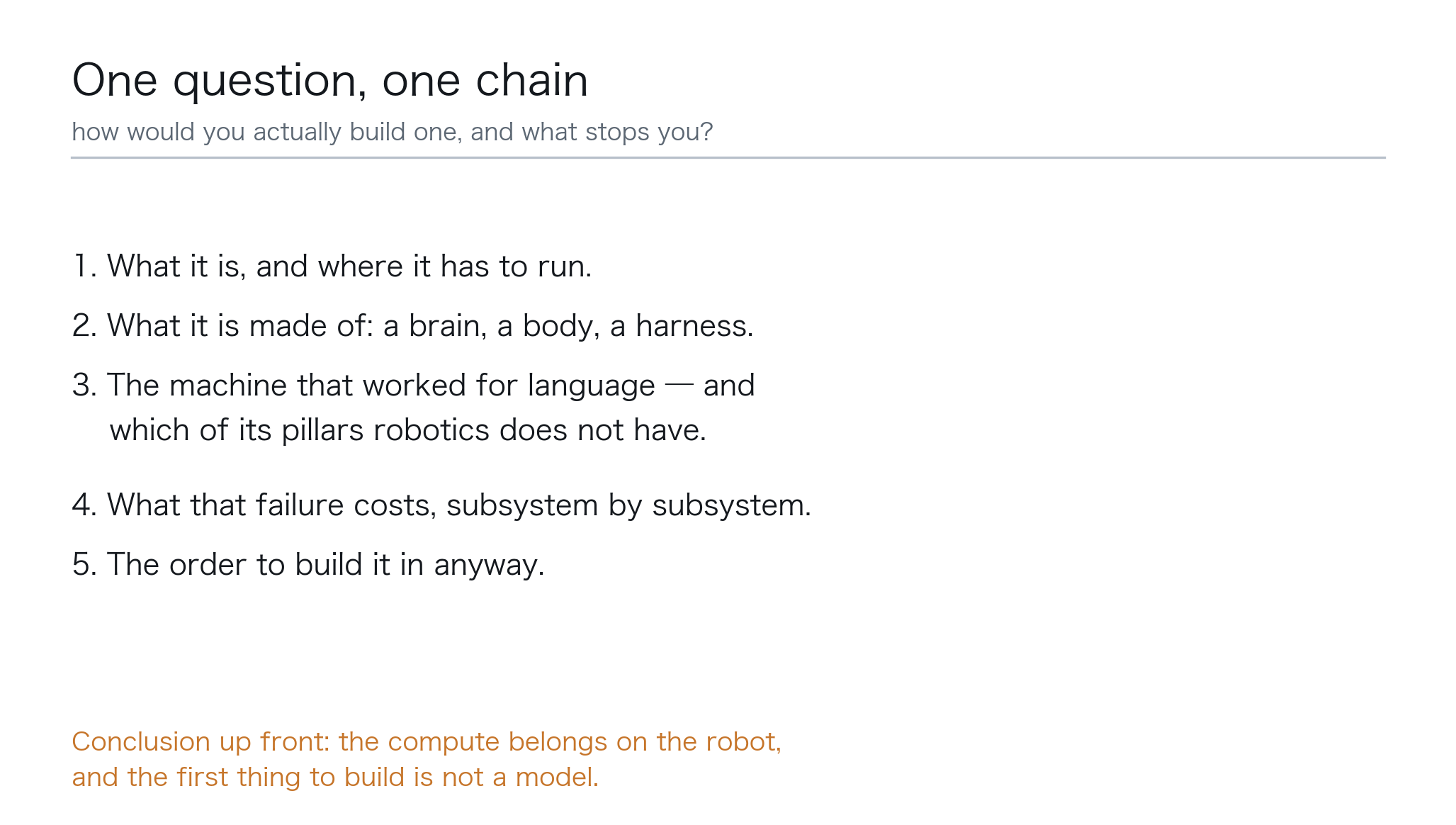
The chain runs in one direction and every step depends on the one before it. The conclusion is stated on the first screen so the rest can be argued with [arXiv:2604.15483].
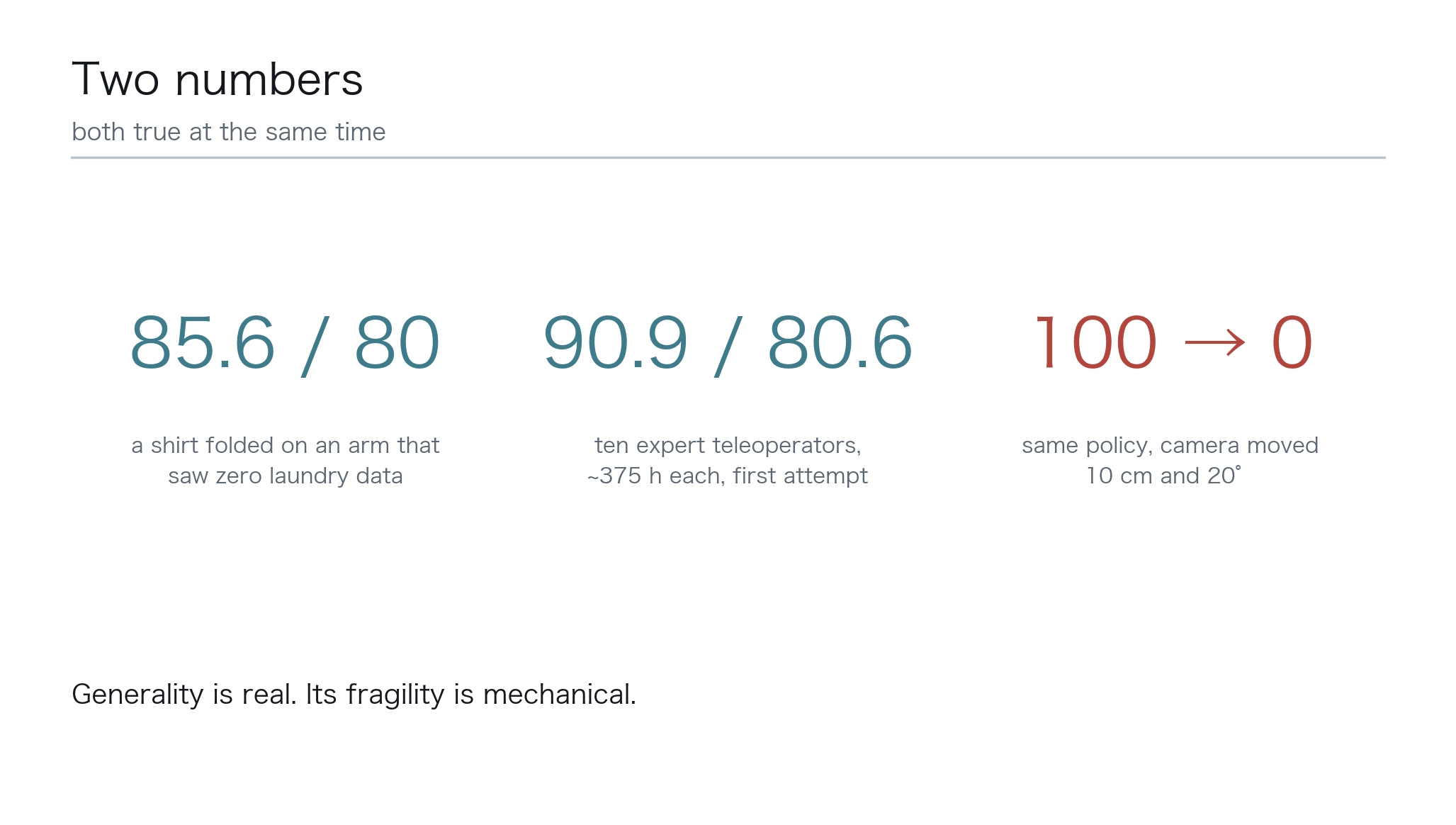
A bimanual UR5e that had never seen a laundry demonstration folded a shirt at 85.6% progress and 80% success; ten expert teleoperators with roughly 375 hours each managed 90.9% and 80.6% on their first attempt [arXiv:2604.15483 §IX]. The same class of policy collapses from 100% to 0% when a camera moves 10 cm and 20 degrees [arXiv:2409.03403].
Part 1 — What it is
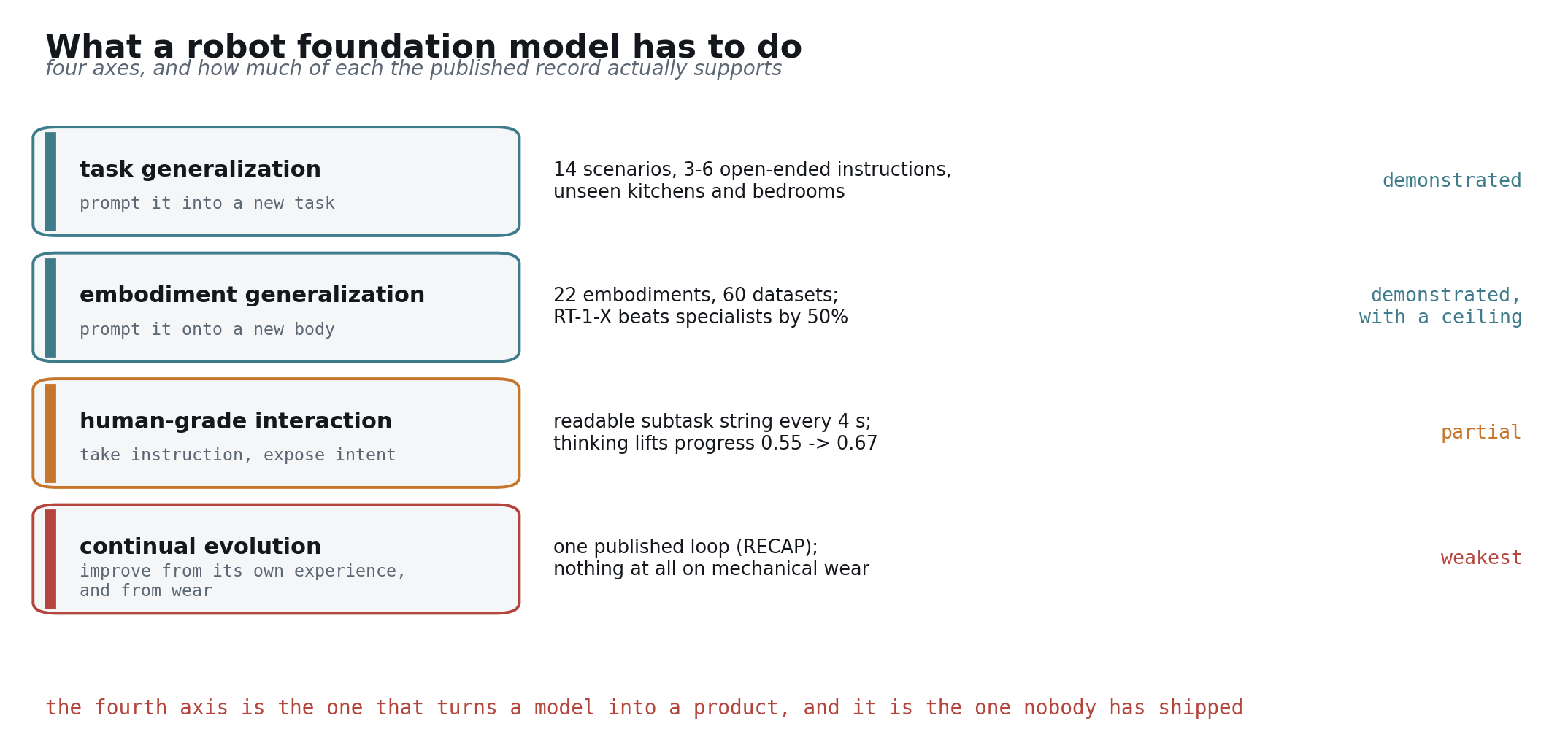
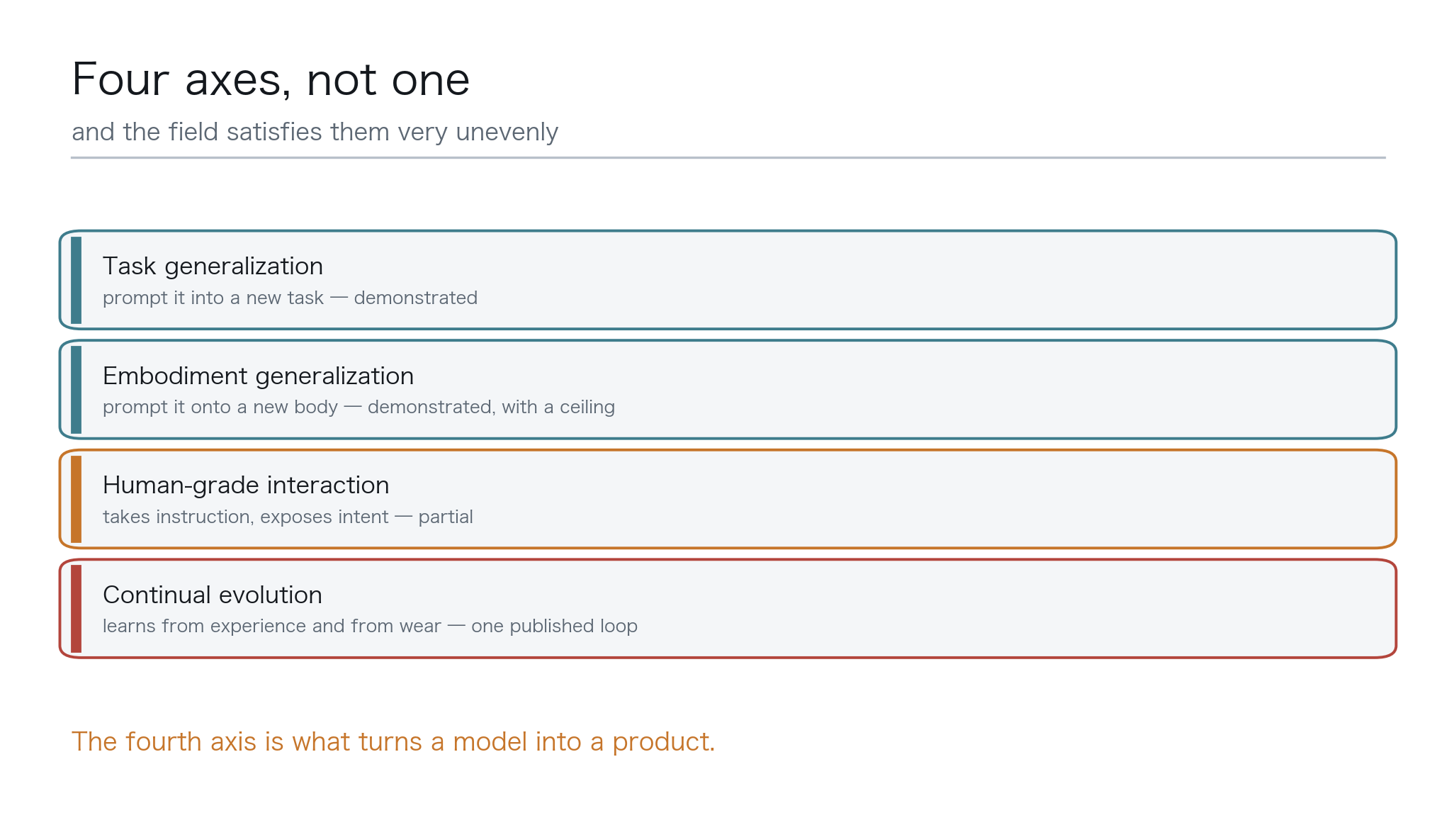
Task generalization is demonstrated across 14 scenarios with 3 to 6 open-ended instructions in unseen rooms [arXiv:2604.15483 §IX-B]. Embodiment generalization is demonstrated with a ceiling, across 22 embodiments and 60 datasets [arXiv:2310.08864]. Continual evolution has exactly one published loop [arXiv:2511.14759], and nothing at all on mechanical wear [arXiv:2104.08212].
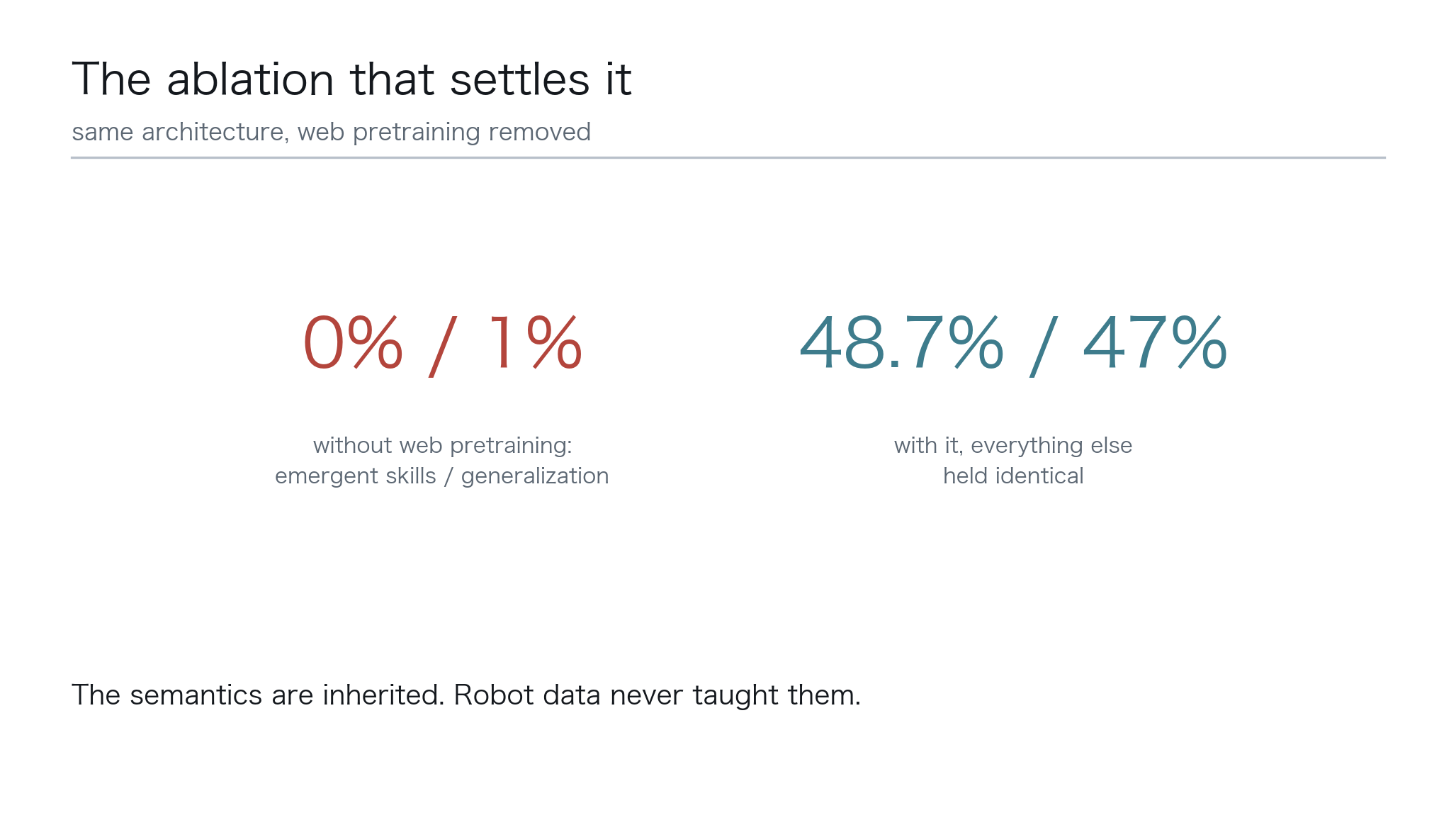
Strip web pretraining from the same architecture and emergent skills go to 0% and generalization to 1%; restore it and they are 48.7% and 47% [arXiv:2310.08864 Table II]. The semantics are inherited, which is the only reason any of this starts from something the internet already paid for [arXiv:2307.15818].
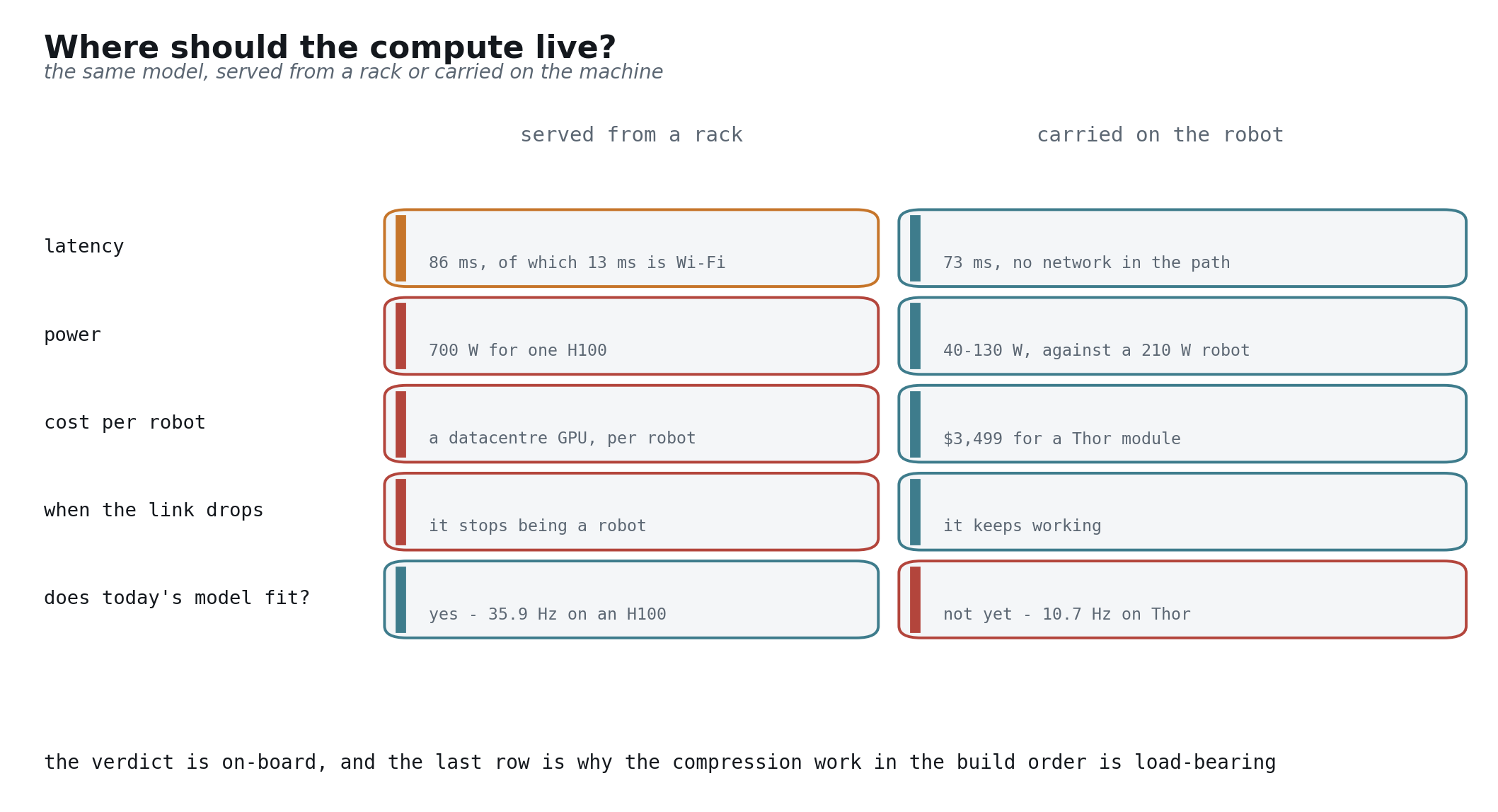
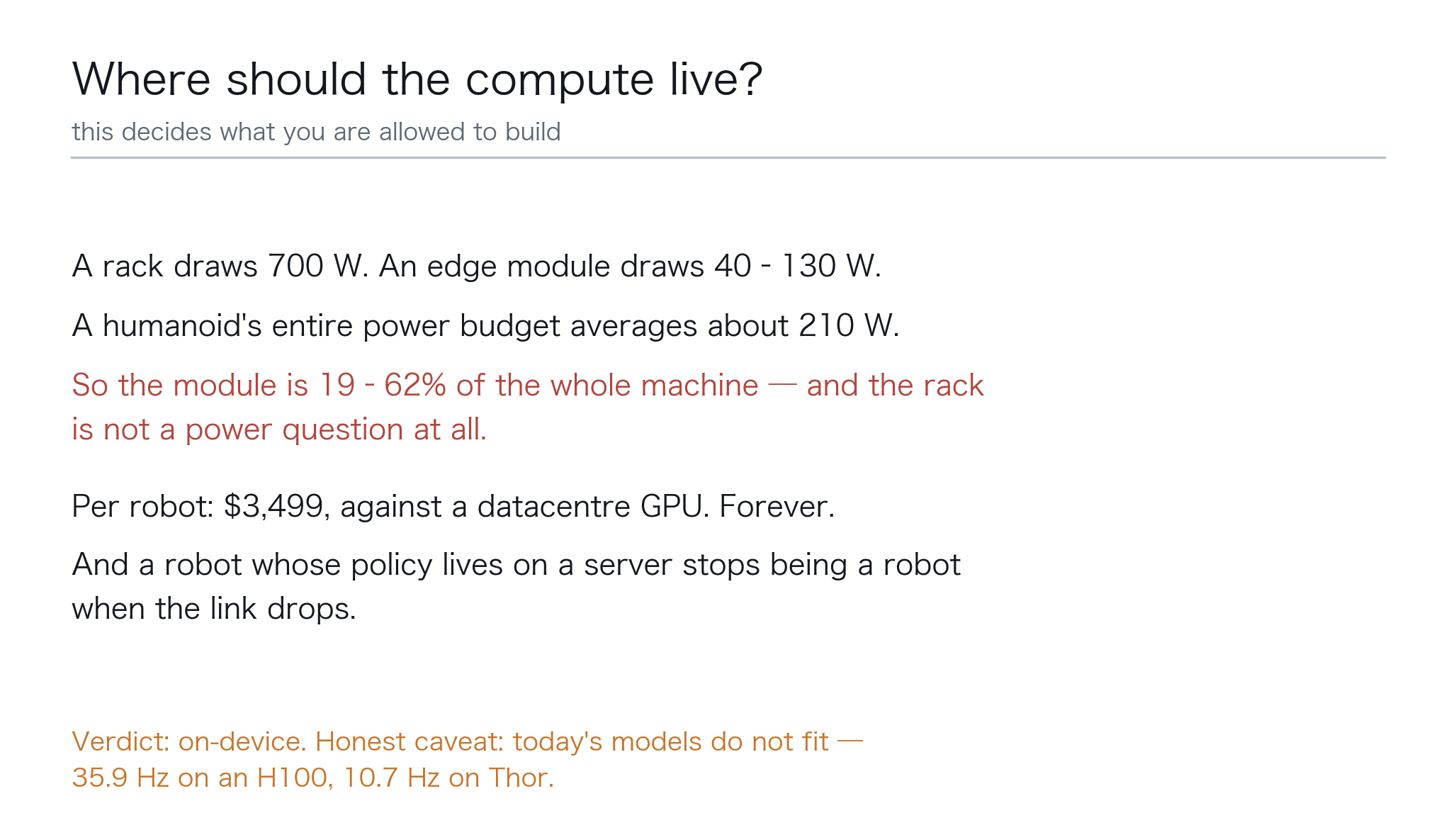
An H100 draws 700 W [spec: NVIDIA H100 SXM]; an edge module draws 40 to 130 W [spec: NVIDIA Jetson AGX Thor]; a humanoid’s whole system averages about 210 W [spec: 1X NEO]. The module is 19% to 62% of the entire power budget [computed: 40 to 130 W against 210 W], and today’s models do not fit — 35.9 Hz on an H100 against 10.7 Hz on Thor [repo: Isaac-GR00T hardware_recommendation.md].
Part 2 — What it is made of
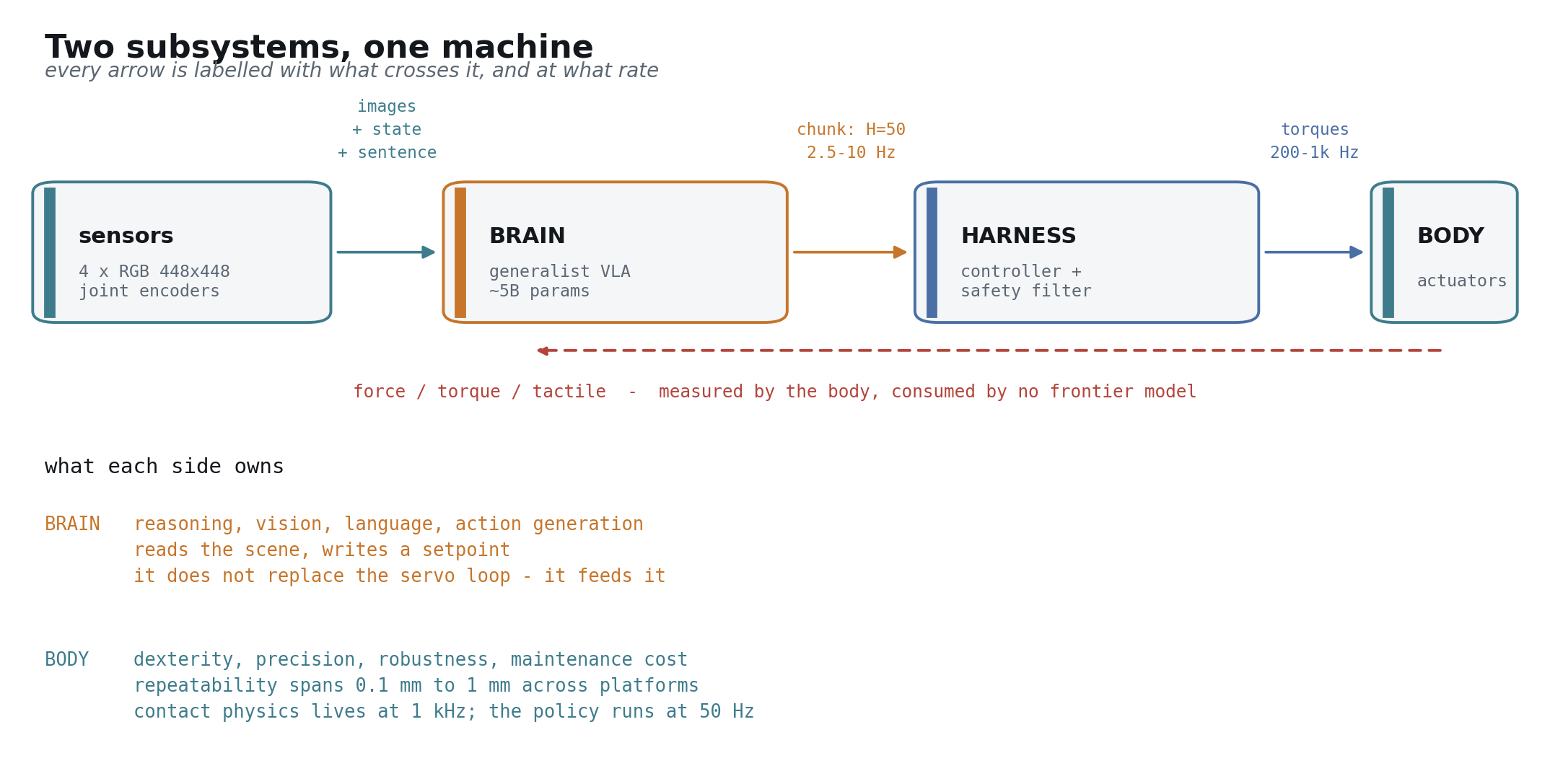
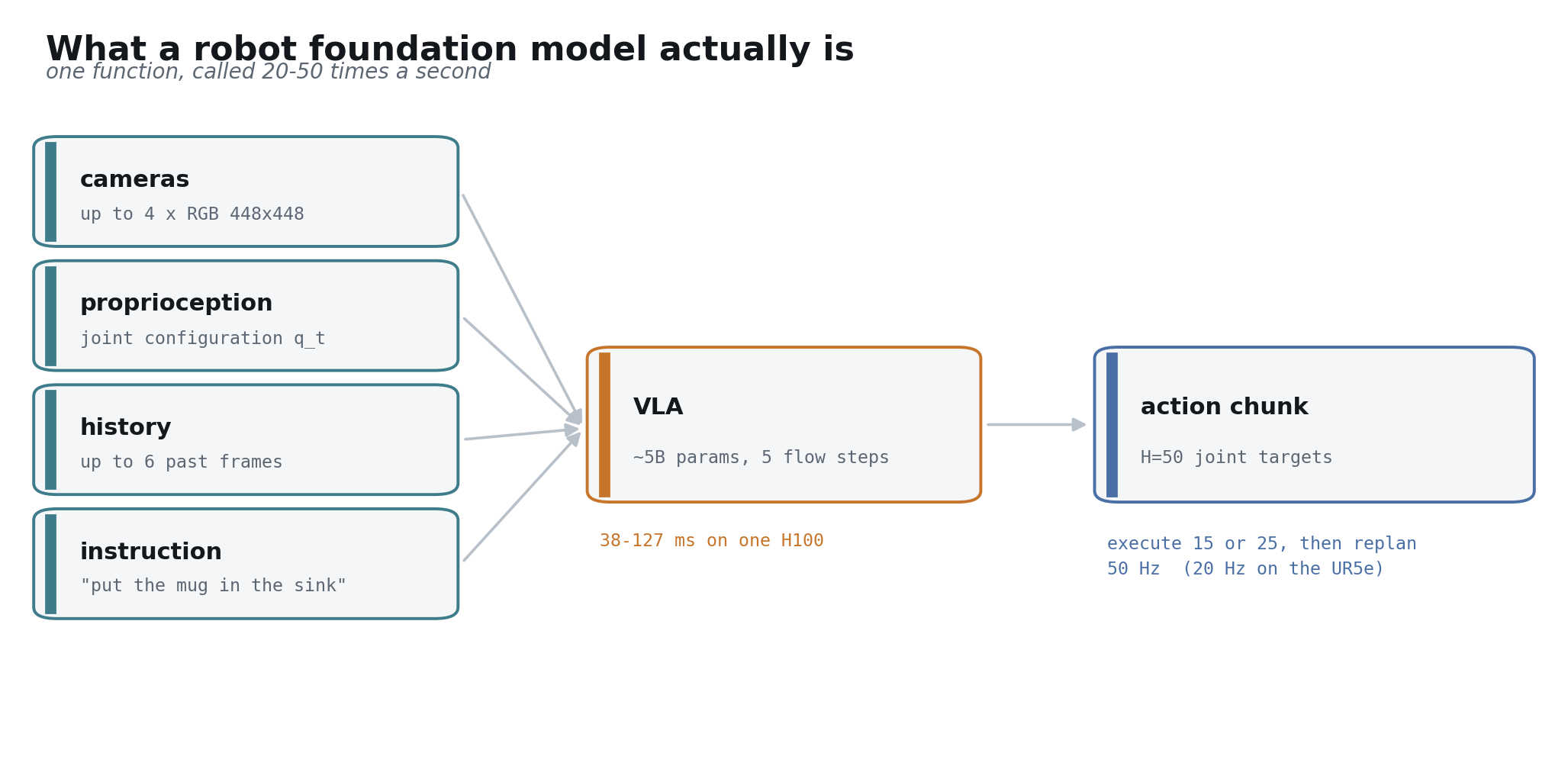
Up to 4 images at 448×448, 6 frames of history, a joint configuration and one sentence go in; 50 future joint targets come out, of which 15 or 25 execute before the model is called again [arXiv:2604.15483 §IV]. That is the brain’s boundary, not the machine’s — the model is a setpoint generator that feeds the servo loop rather than replacing it [arXiv:2604.15483 §VII].
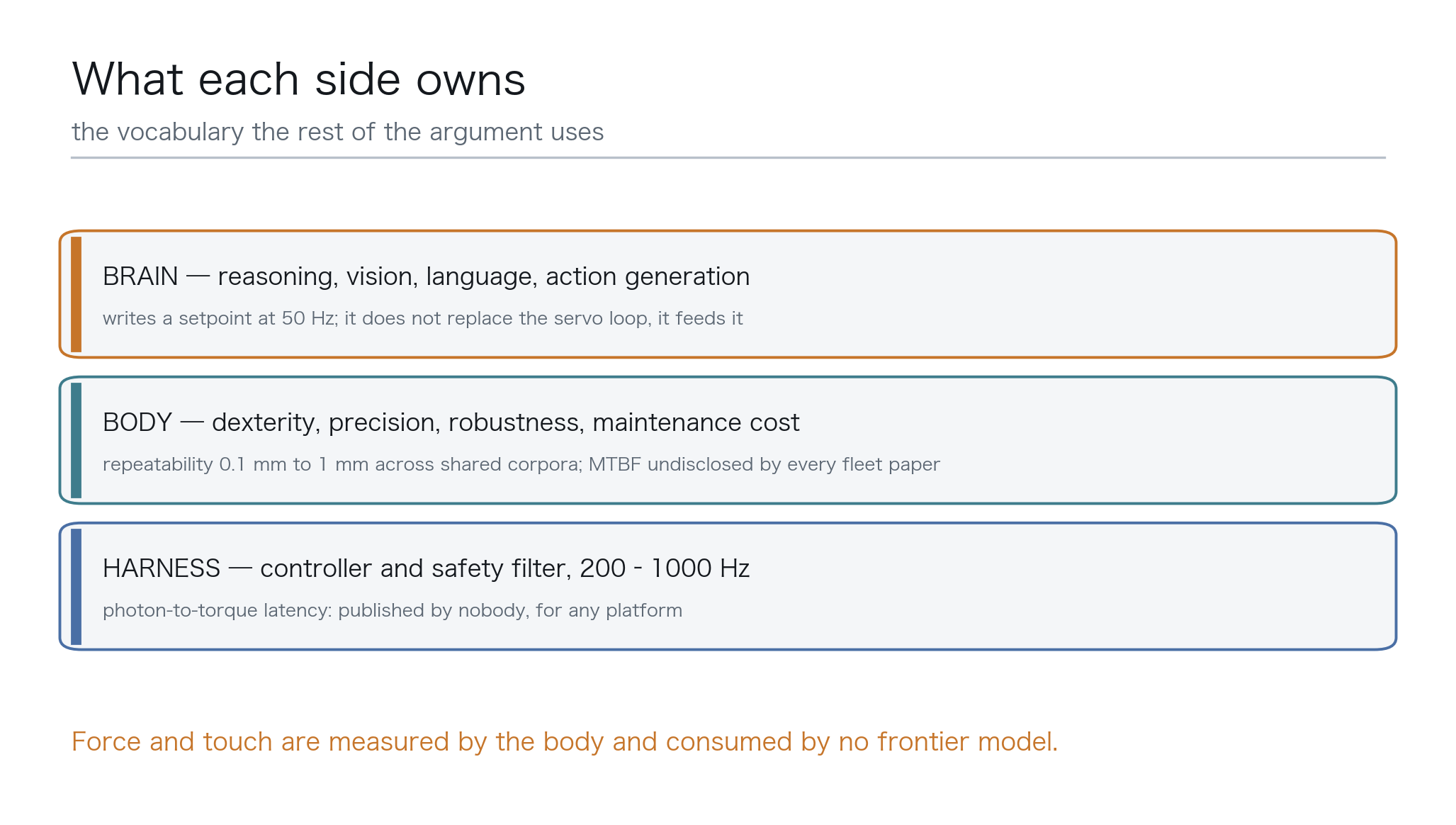
The brain writes setpoints at 50 Hz [arXiv:2604.15483 §VII] against an arm that accepts commands at 1 kHz [spec: Franka Research 3]. Repeatability spans 0.1 mm to 1 mm across platforms sharing one corpus [computed: 1 mm against 0.1 mm]. Force and touch are measured by the body and consumed by no frontier model [arXiv:2505.22159].
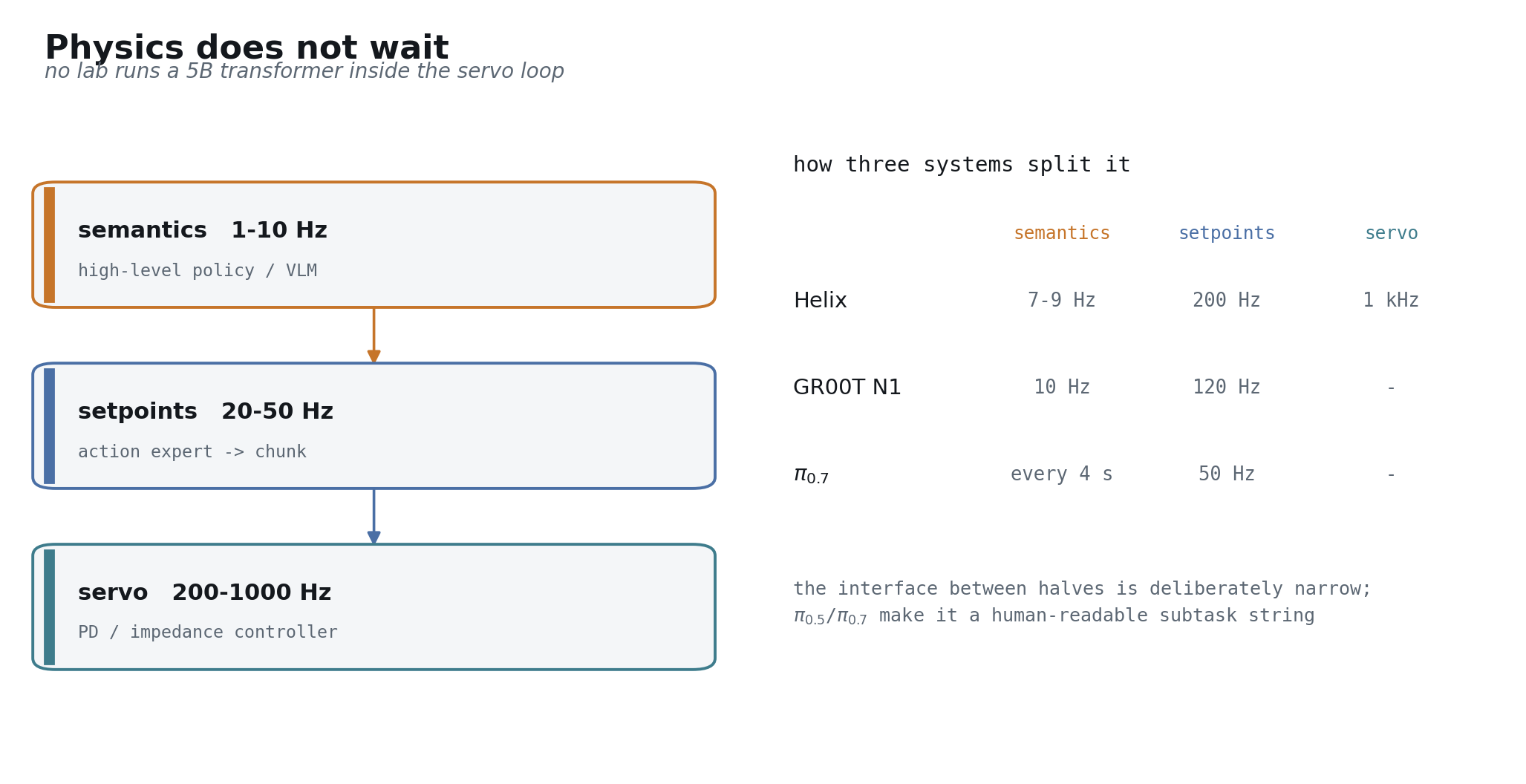
Nobody runs a 5B transformer inside a servo loop, so every serious system splits into halves at different rates [arXiv:2503.14734]. Where labs disagree is the width of the seam — a latent vector [blog: Figure Helix], a feature sequence [arXiv:2503.14734], or a human-readable subtask string that costs bandwidth and buys debuggability [arXiv:2604.15483 §VI].
Part 3 — The machine that worked
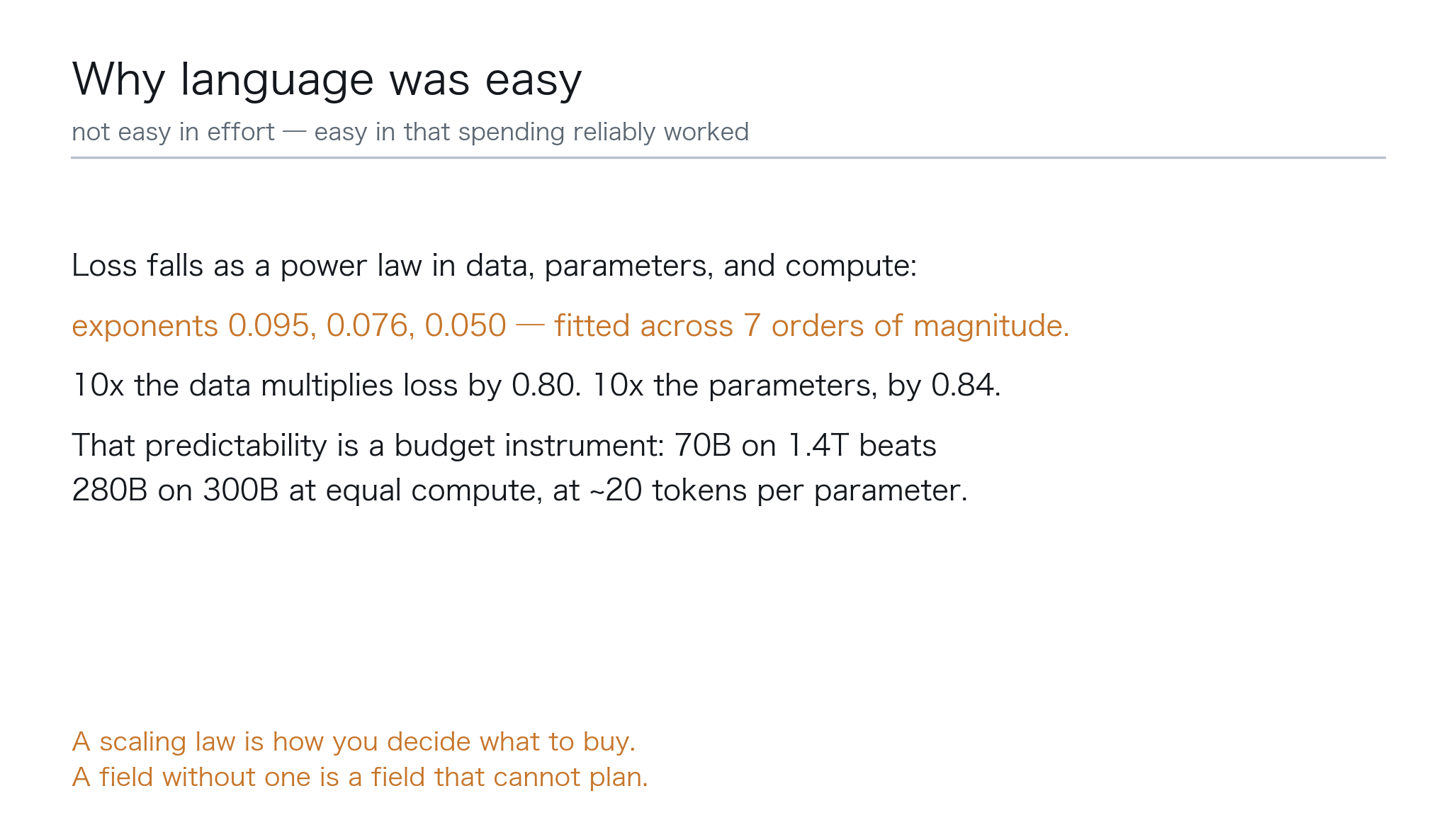
Loss falls as a power law with exponents 0.095, 0.076 and 0.050, fitted across 7 orders of magnitude [arXiv:2001.08361]. That predictability is a budget instrument: 70B on 1.4T beats 280B on 300B at equal compute, at about 20 tokens per parameter [arXiv:2203.15556].
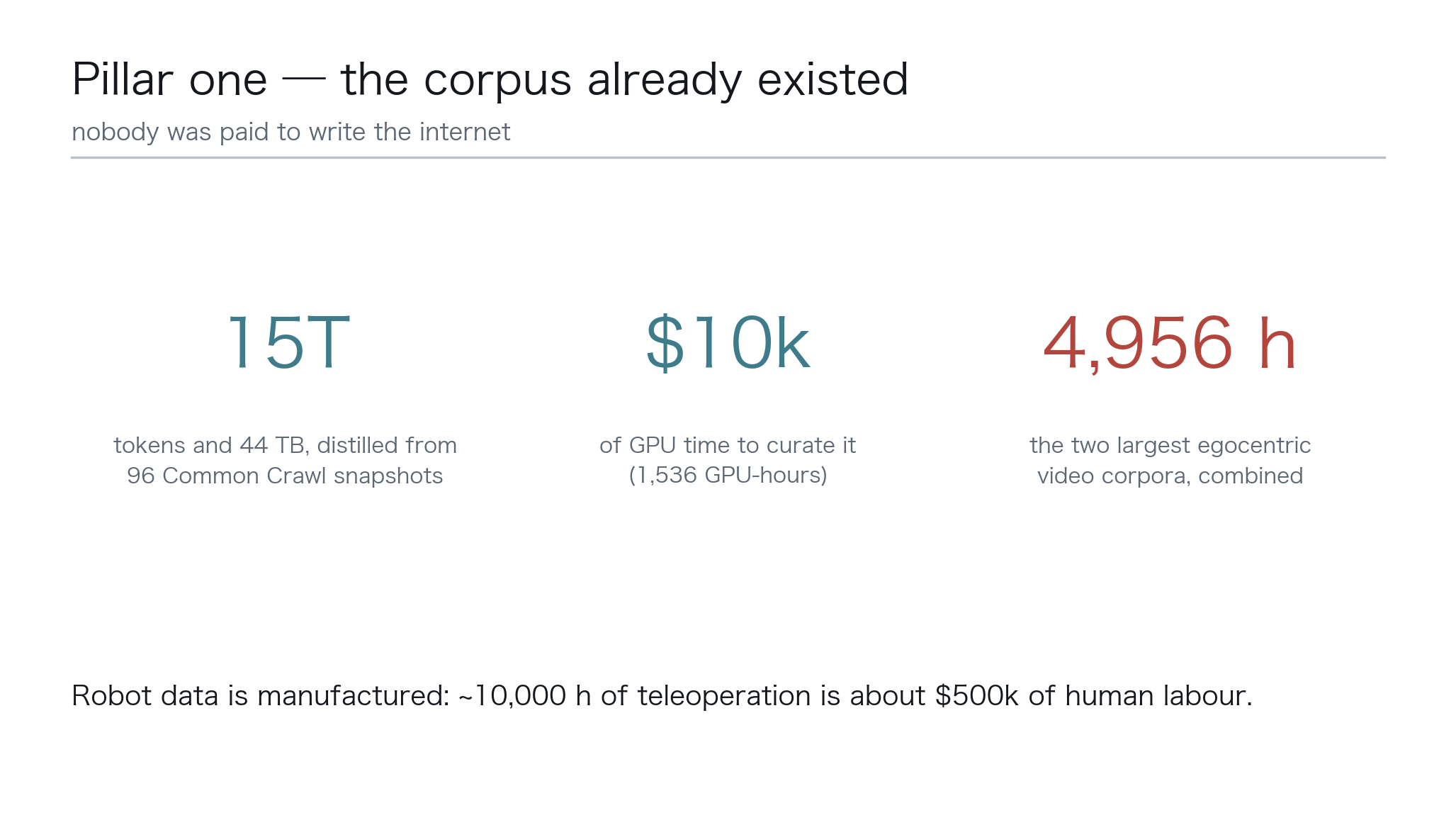
One open pipeline distils 96 Common Crawl snapshots into 15T tokens and 44 TB for 1,536 GPU-hours [arXiv:2406.17557], roughly $10k of compute [computed: 1,536 GPU-hours at commodity rates]. The two largest egocentric video corpora total 4,956 hours [computed: 3,670 h plus 1,286 h], and robot data is manufactured — about 10,000 hours of teleoperation is roughly $500k of labour [computed: 10,000 h at $50 per hour].
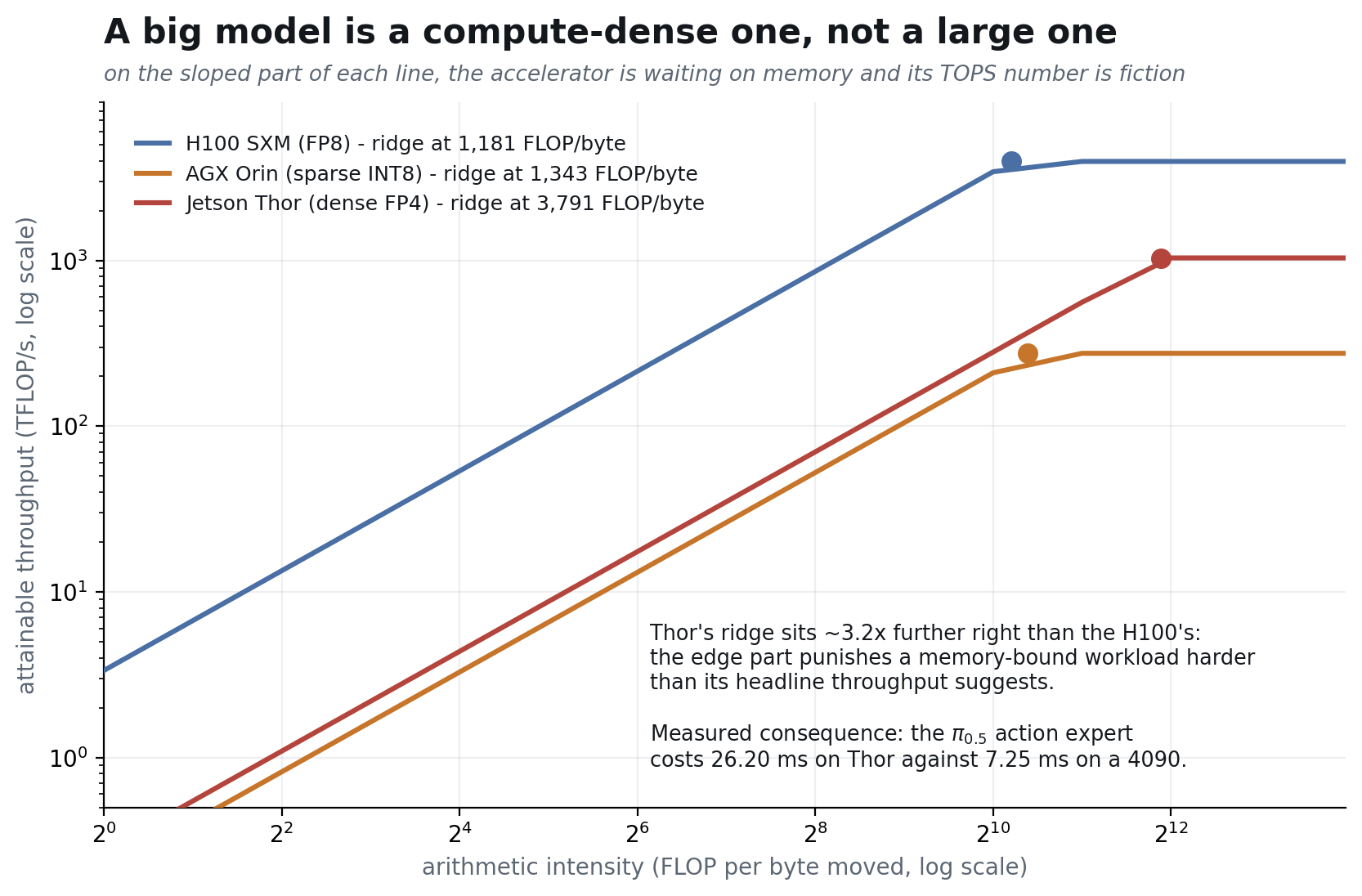
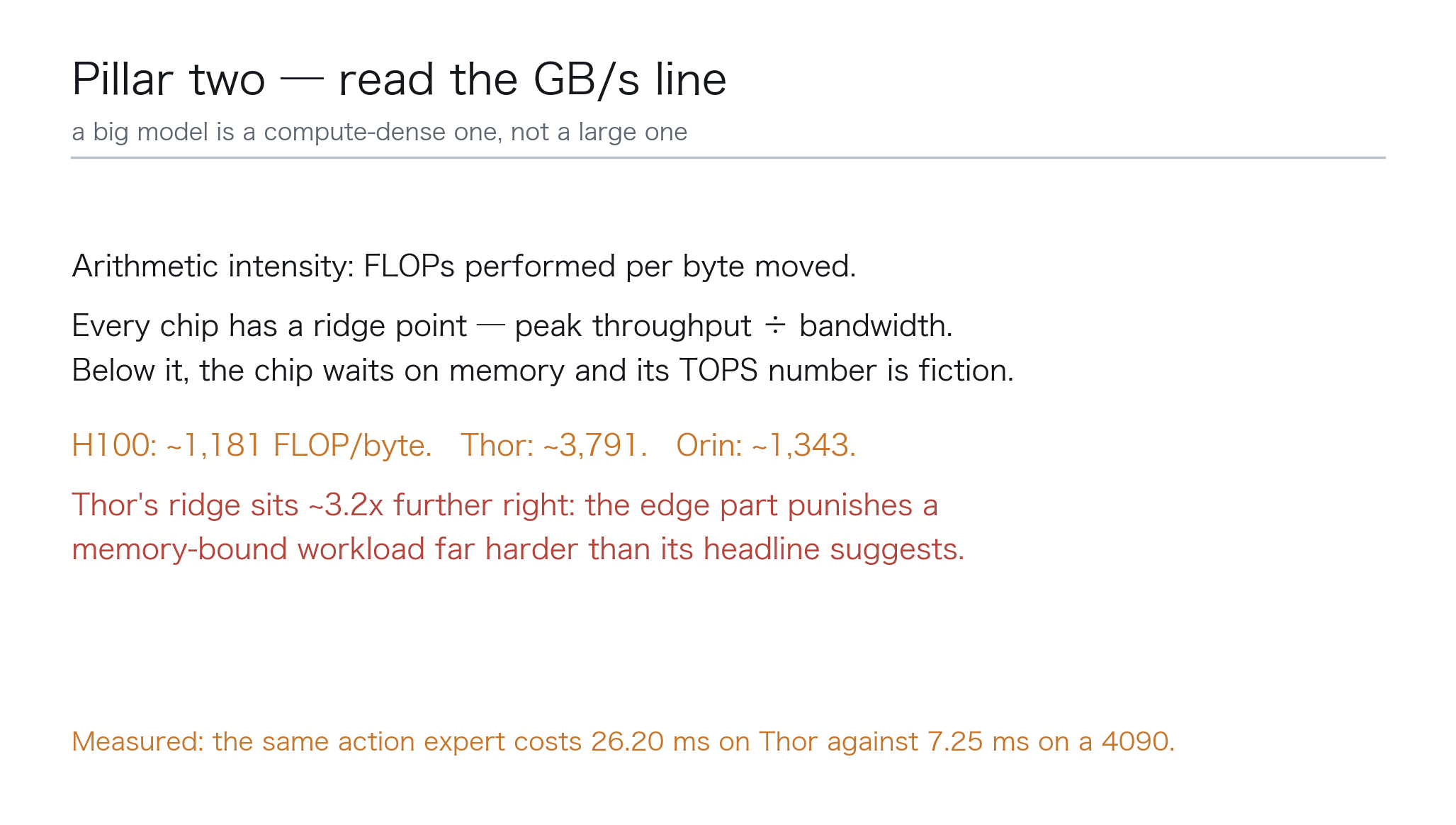
Ridge points, computed from datasheets: about 1,181 FLOP/byte for an H100, about 3,791 for a Thor, about 1,343 for an Orin [computed: 3,958 TFLOPS over 3.35 TB/s]. Thor’s sits about 3.2x further right [computed: 3,791 over 1,181], and the measured consequence is an action expert costing 26.20 ms there against 7.25 ms on a consumer GPU [arXiv:2602.18397].
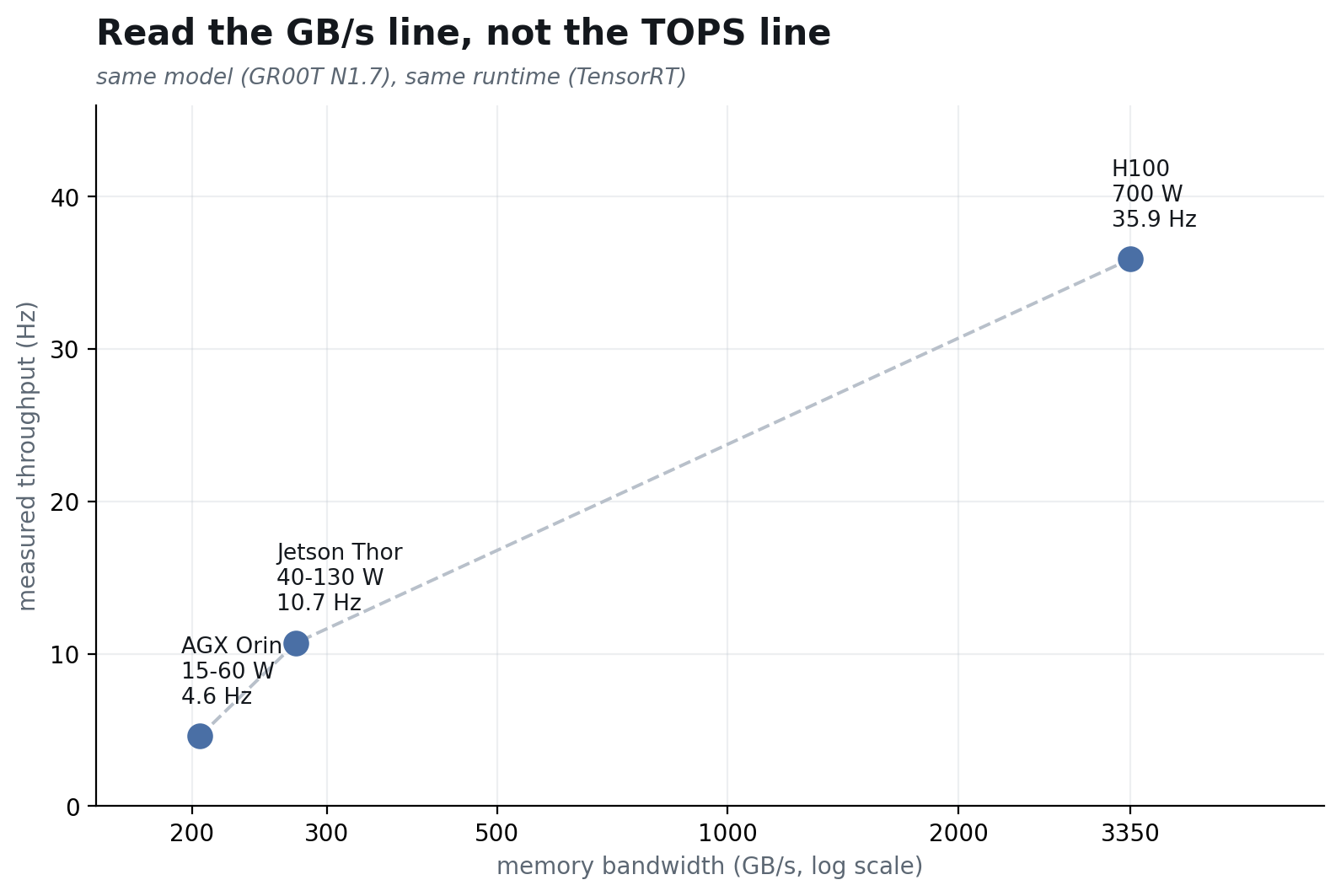
Same model, same runtime, three accelerators: throughput tracks the GB/s line rather than the TOPS line [repo: Isaac-GR00T hardware_recommendation.md].
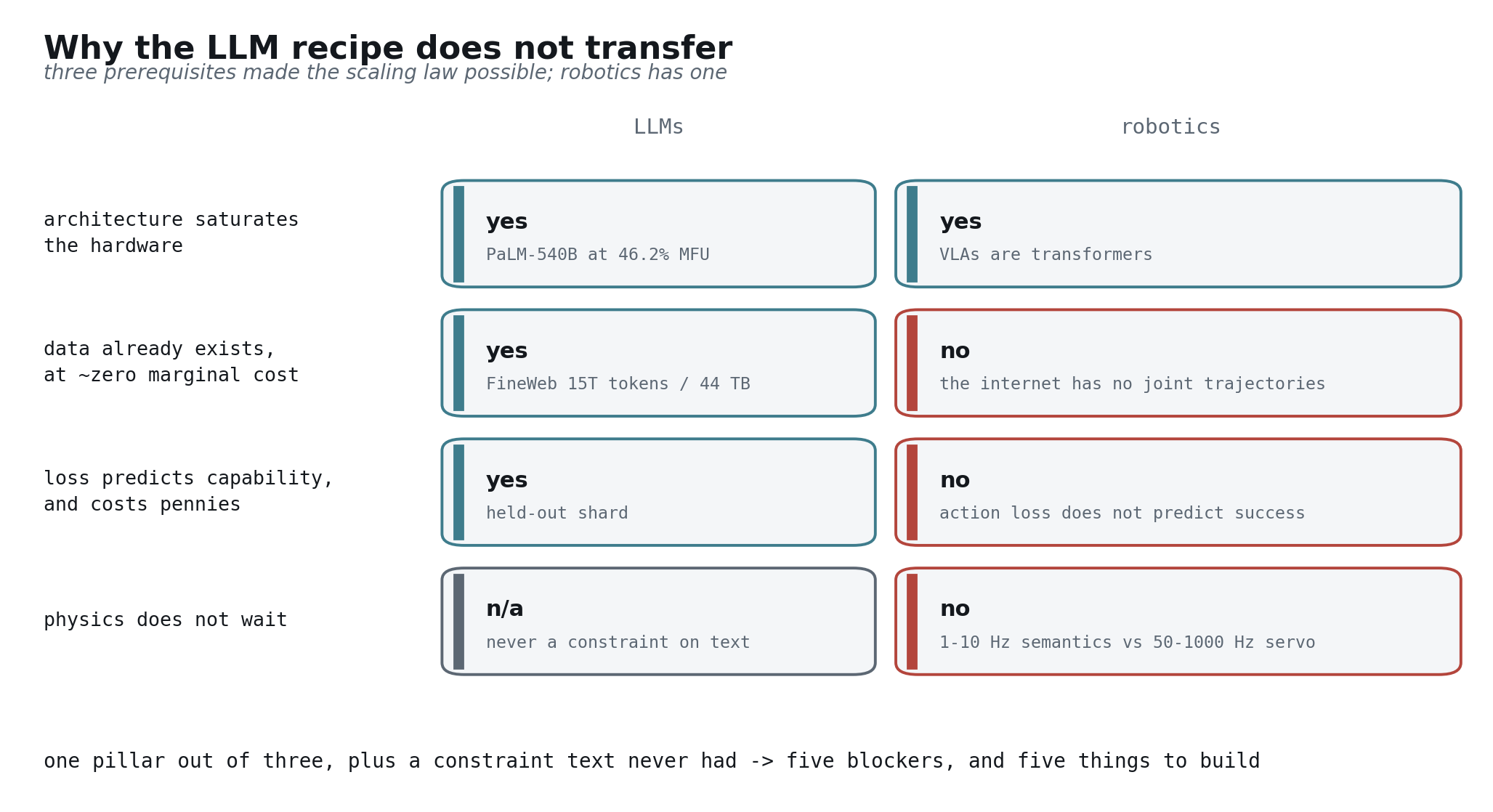
Robotics satisfies the compute pillar. It does not satisfy the data pillar or the infrastructure pillar in the forms that made them powerful, and it carries a fourth constraint text never faced [arXiv:2604.15483 §VII].
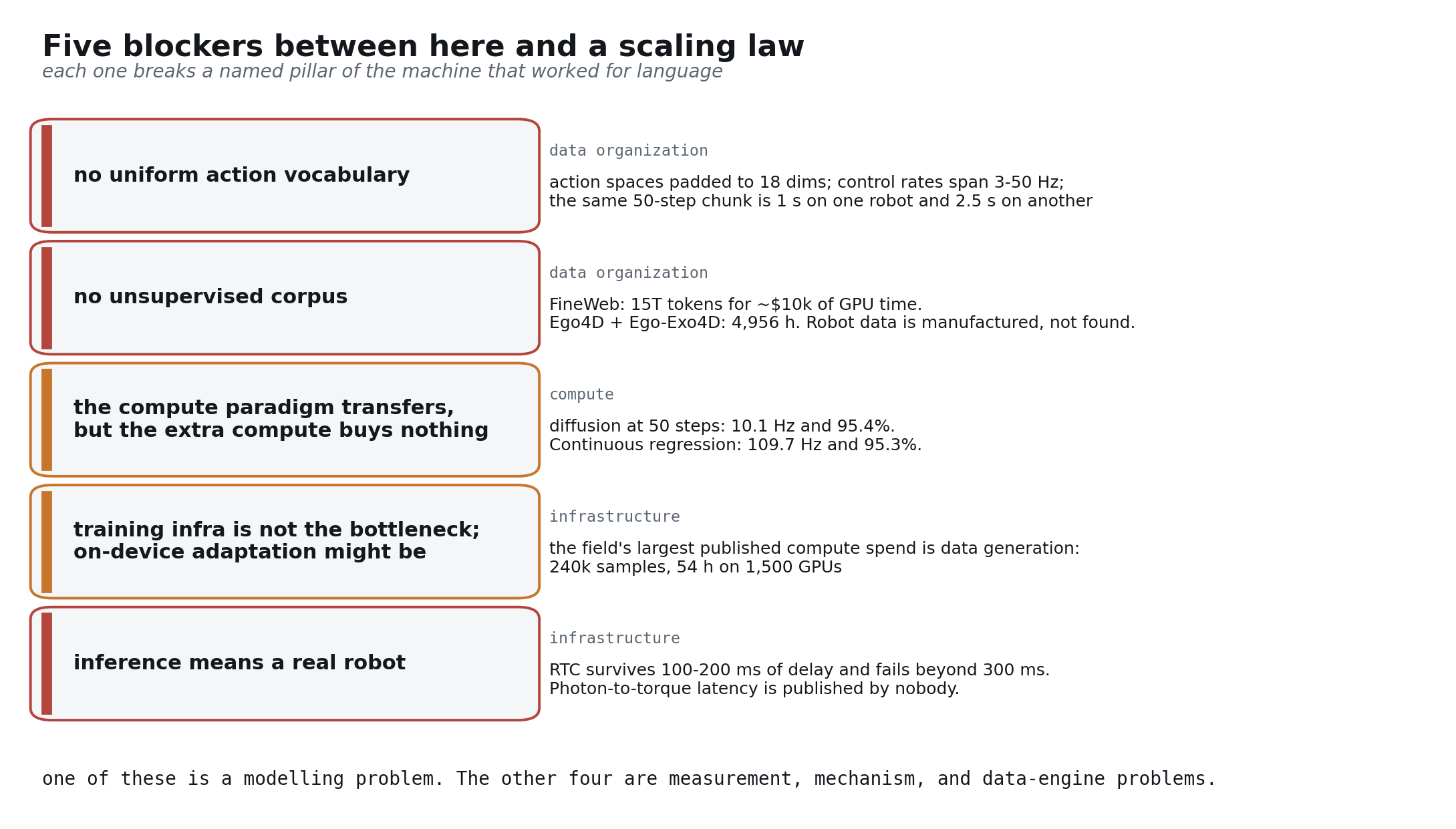
Action spaces are padded to 18 dimensions and rates span 3 Hz to 50 Hz [arXiv:2410.24164]. Diffusion at 50 steps buys 10.1 Hz at 95.4% where continuous regression buys 109.7 Hz at 95.3% [arXiv:2502.19645]. Real-time chunking survives 100–200 ms and fails past 300 ms [arXiv:2506.07339]. One of the five is a modelling problem.
Part 4 — What it costs
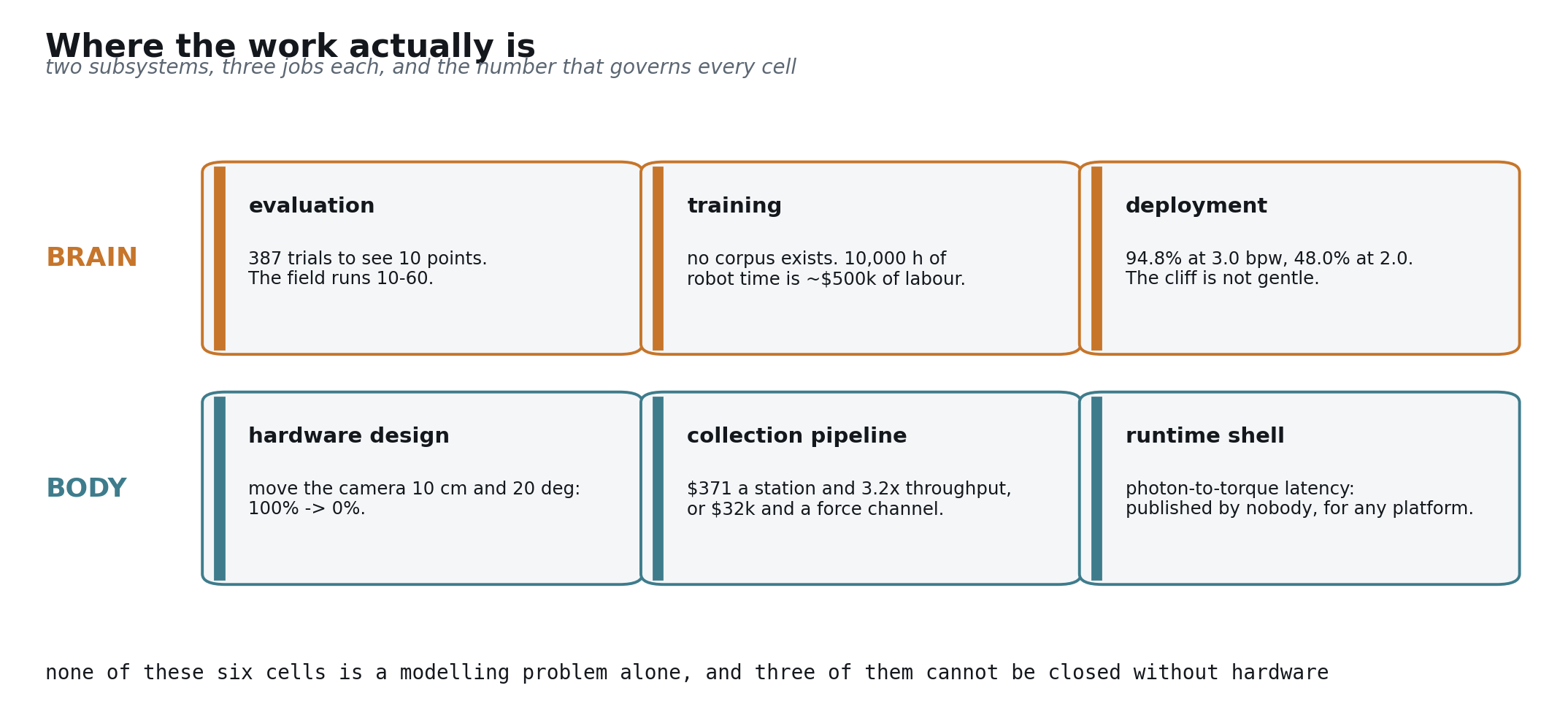
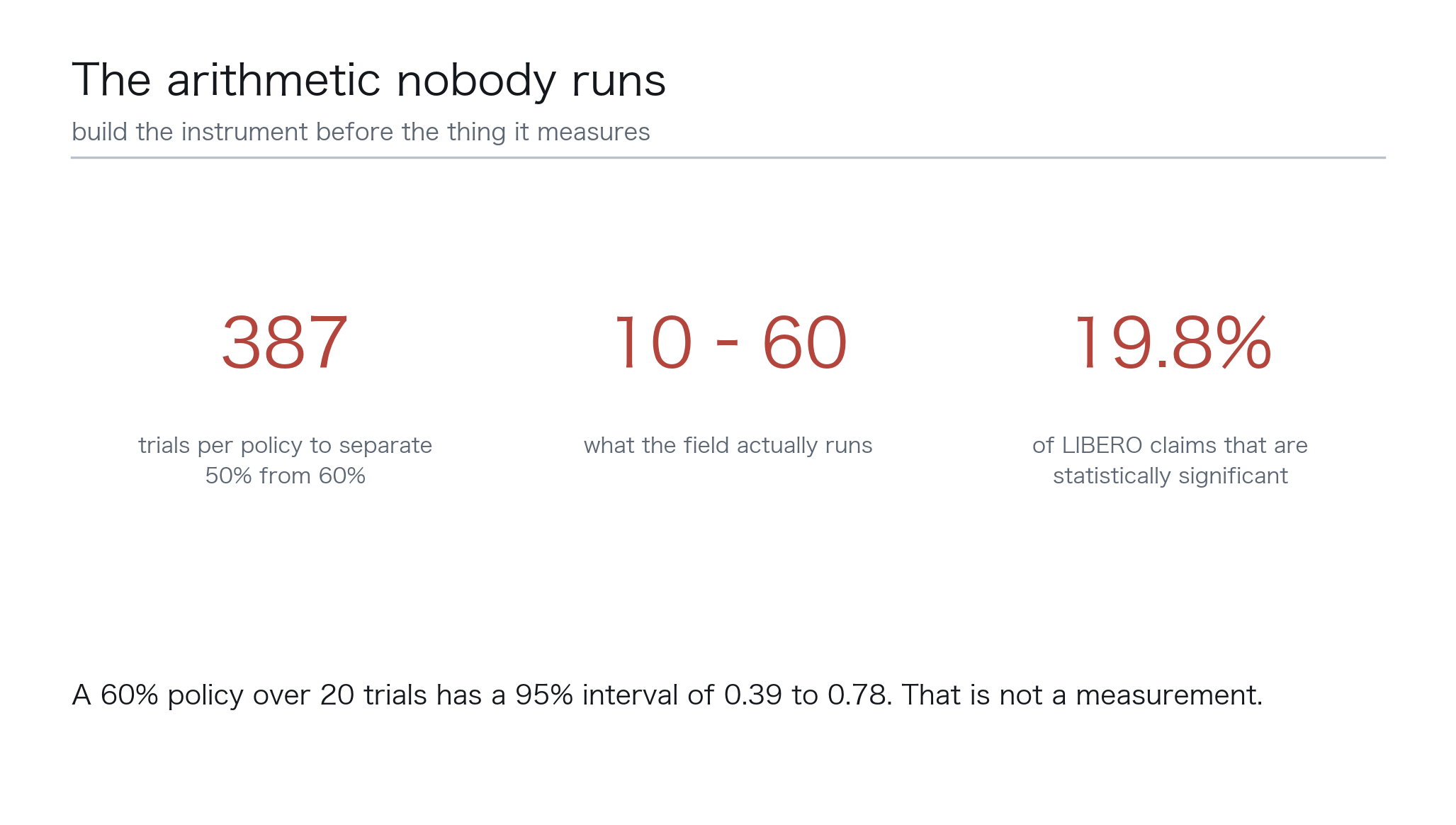
Separating a 50% policy from a 60% policy needs 387 trials [computed: two-proportion test, alpha 0.05, 80% power]; the field runs 10 to 60 [arXiv:2506.18123]. Only 19.8% of LIBERO claims are statistically significant [arXiv:2606.04233], and models scoring 98% and 92% collapse to 0.0% under position perturbation [arXiv:2510.03827].
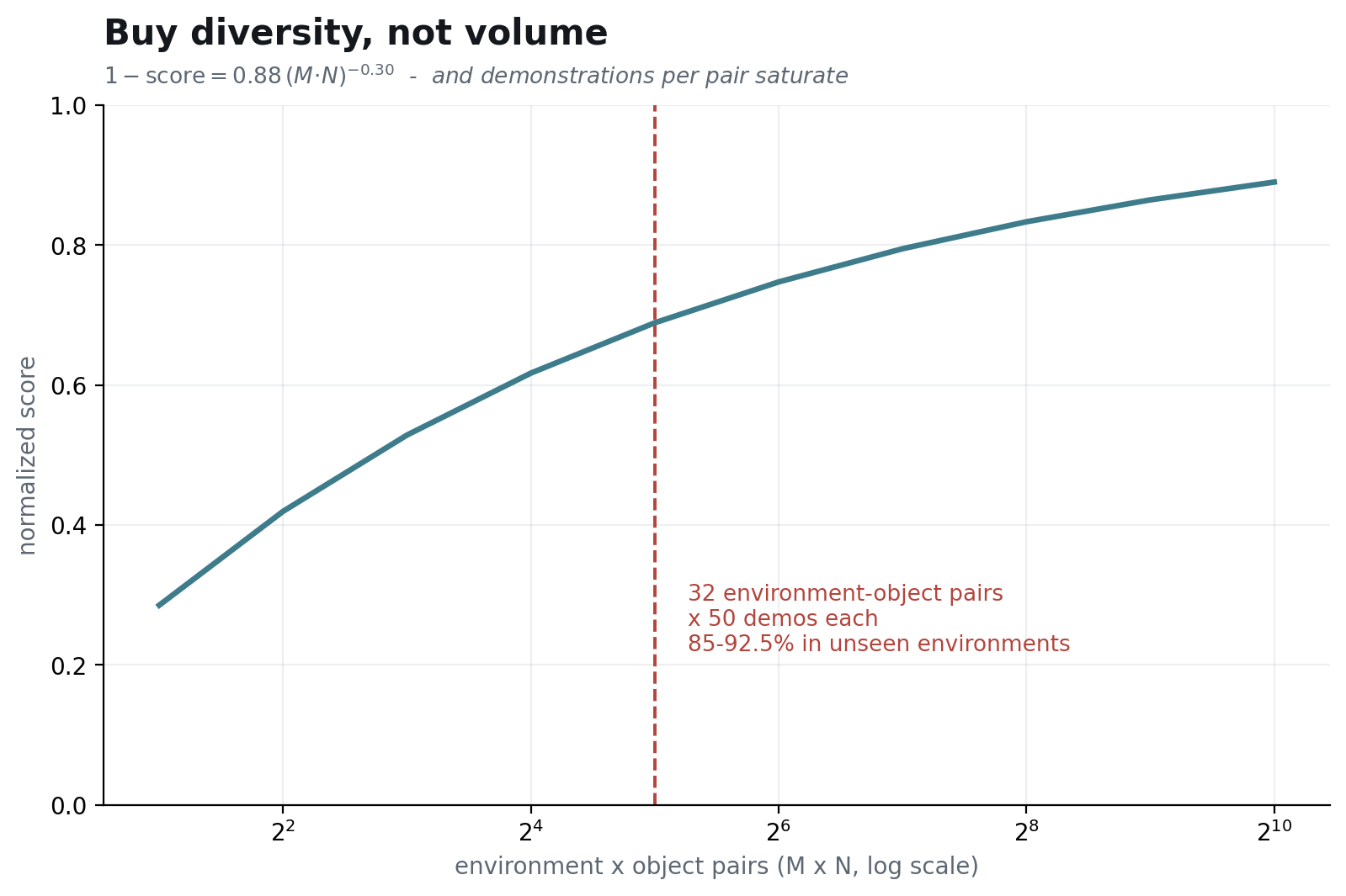
The one replicated law is over diversity: 32 environment-object pairs at 50 demonstrations each reached 85% to 92.5% in unseen environments, collected by 4 people in an afternoon [arXiv:2410.18647].
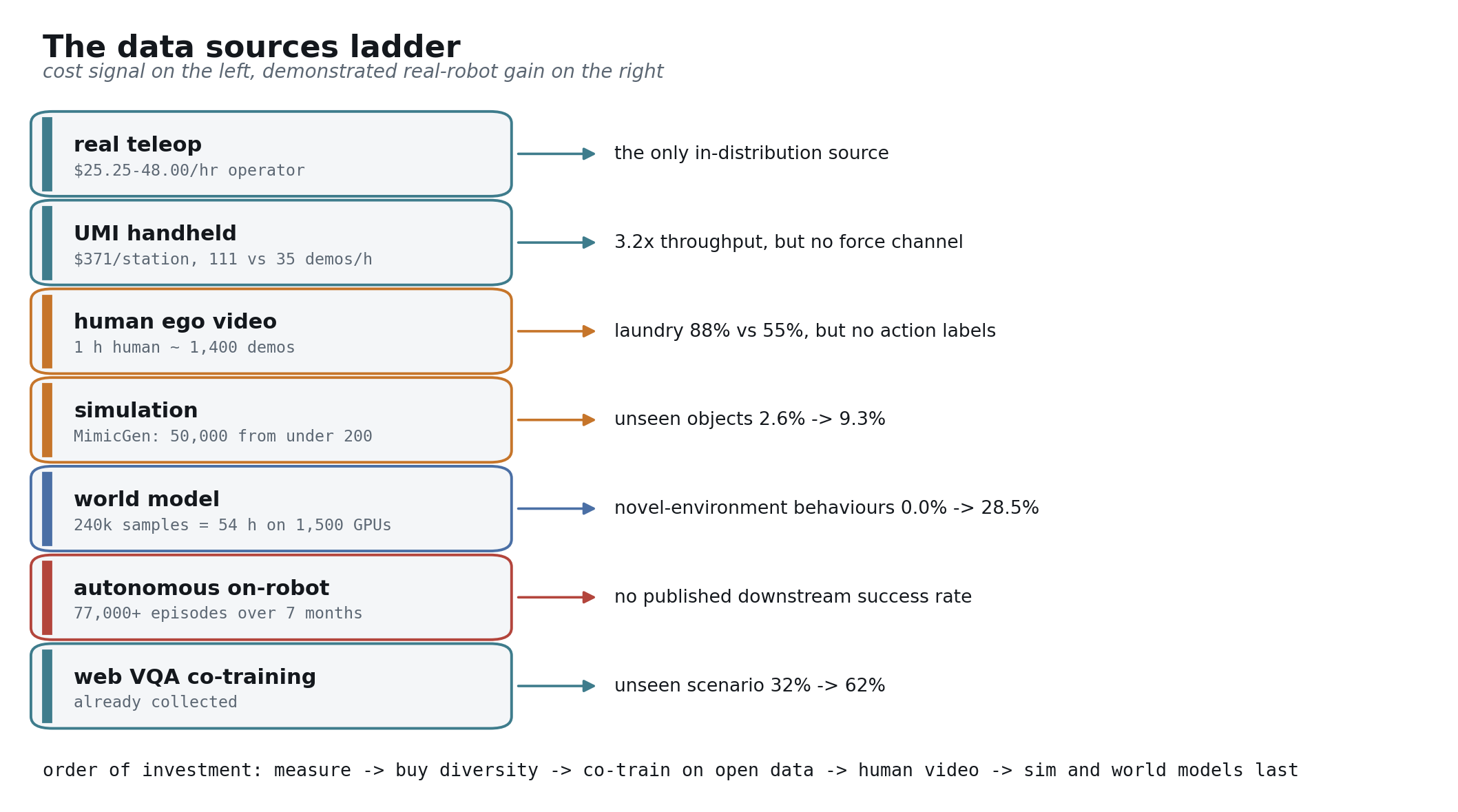
A handheld station costs $371 and produces 111 demonstrations an hour against teleoperation’s 35 [arXiv:2402.10329]. An hour of human video is worth about 1,400 demonstrations where an hour of robot time is worth 135 [arXiv:2410.24221].
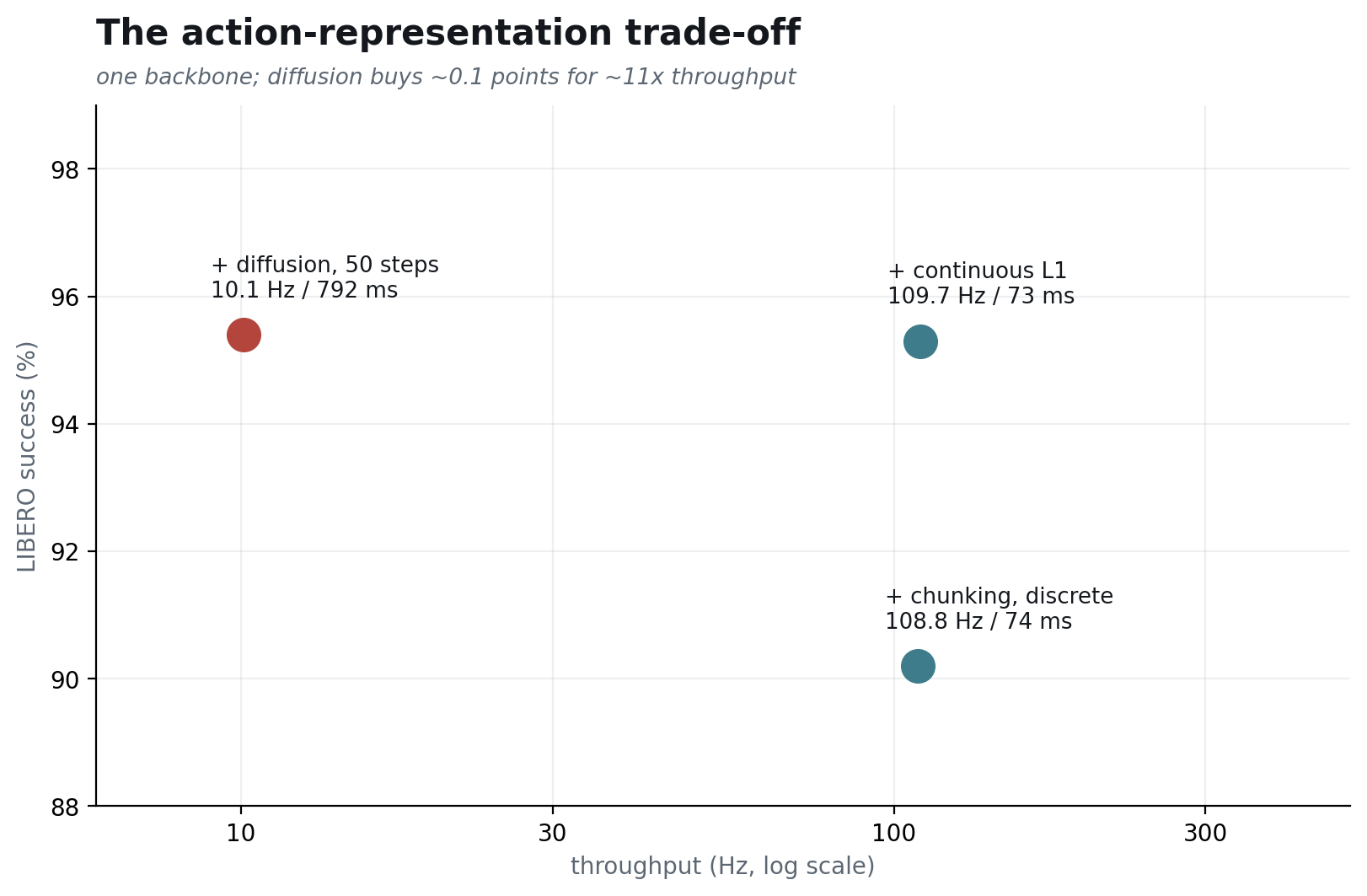
Holding the backbone fixed, diffusion’s extra compute buys about a tenth of a point for roughly 11x the throughput [computed: 109.7 Hz against 10.1 Hz].
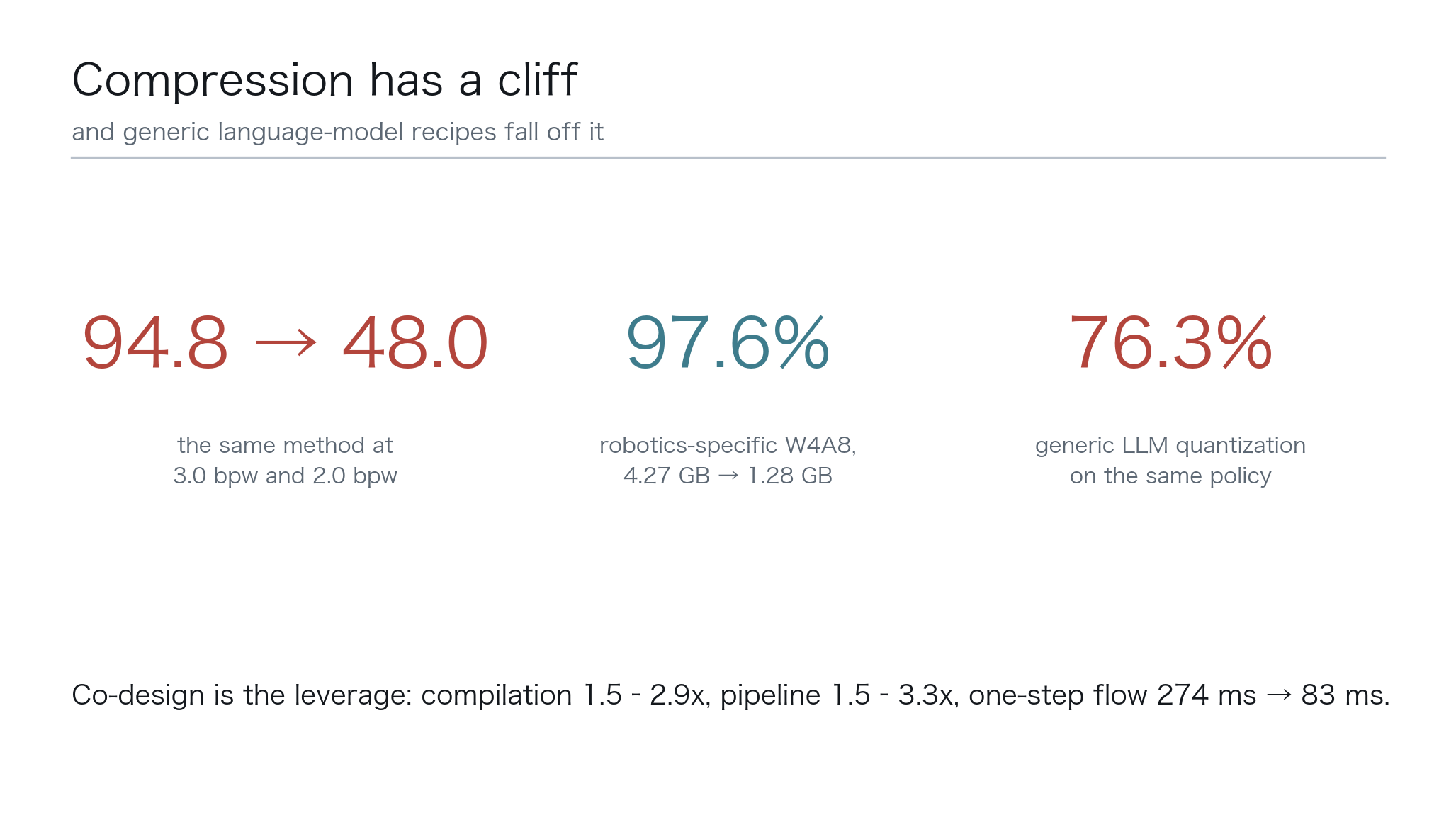
One method holds 94.8% at 3.0 bits per weight and falls to 48.0% at 2.0 [arXiv:2605.24011]. Robotics-specific W4A8 reaches 97.6% while cutting 4.27 GB to 1.28 GB, where generic quantization lands at 76.3% [arXiv:2602.20309].
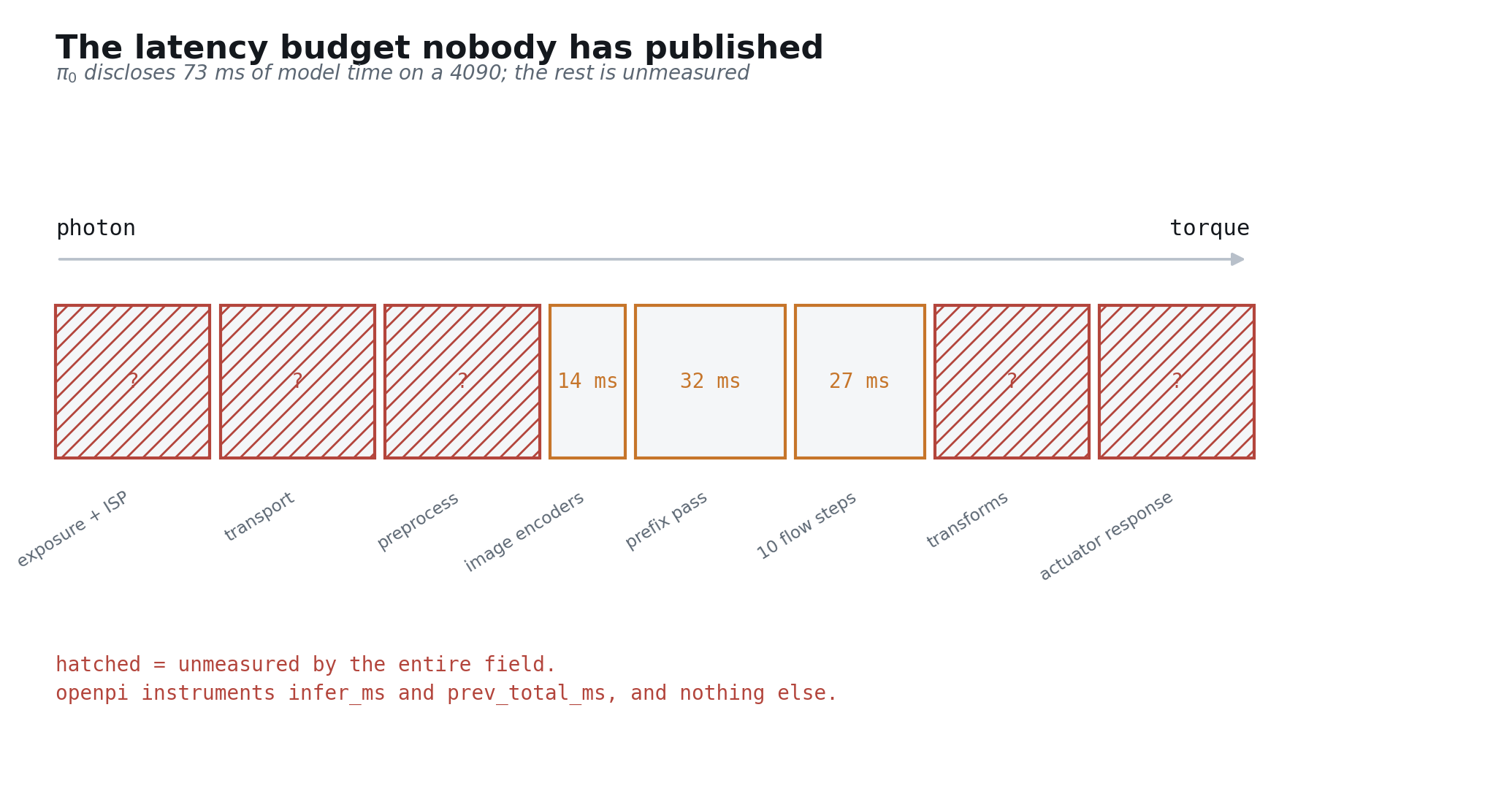
The model’s own time is the measured third — 14 ms of encoders, 32 ms of prefix, 27 ms of flow steps [arXiv:2410.24164]. Everything before and after it is unmeasured by the entire field [repo: openpi websocket_policy_server.py].
Part 5 — The build order
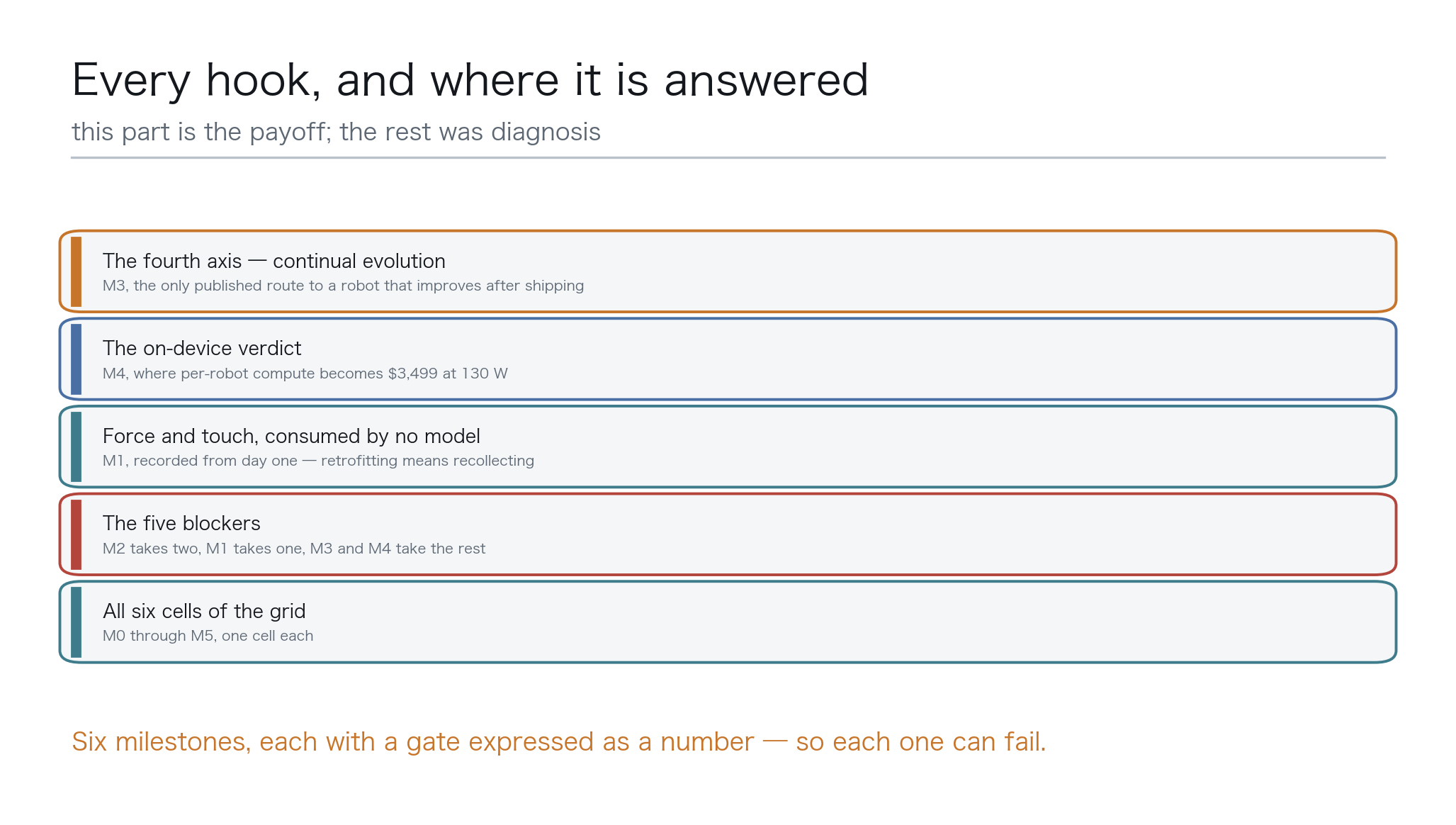
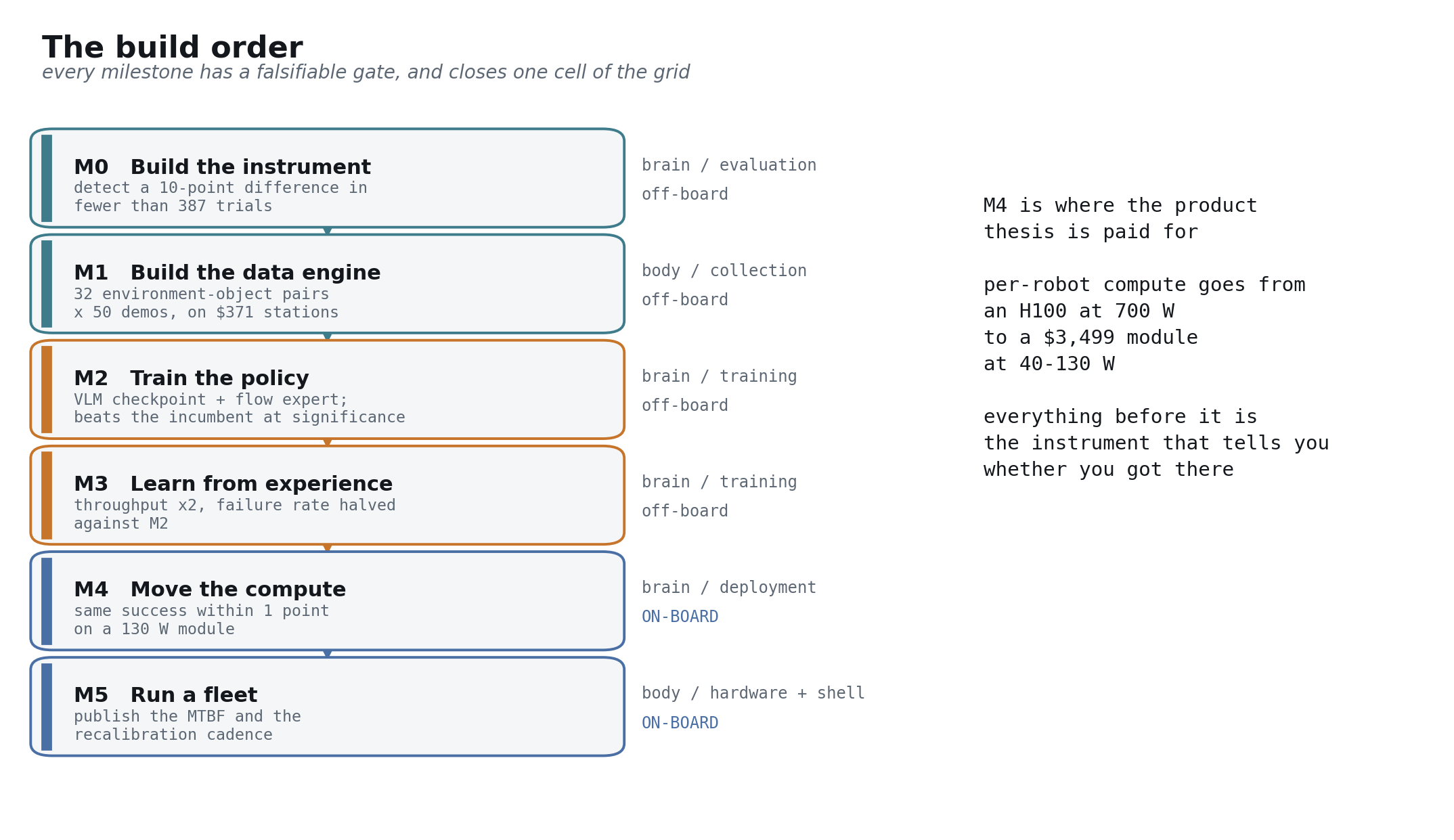
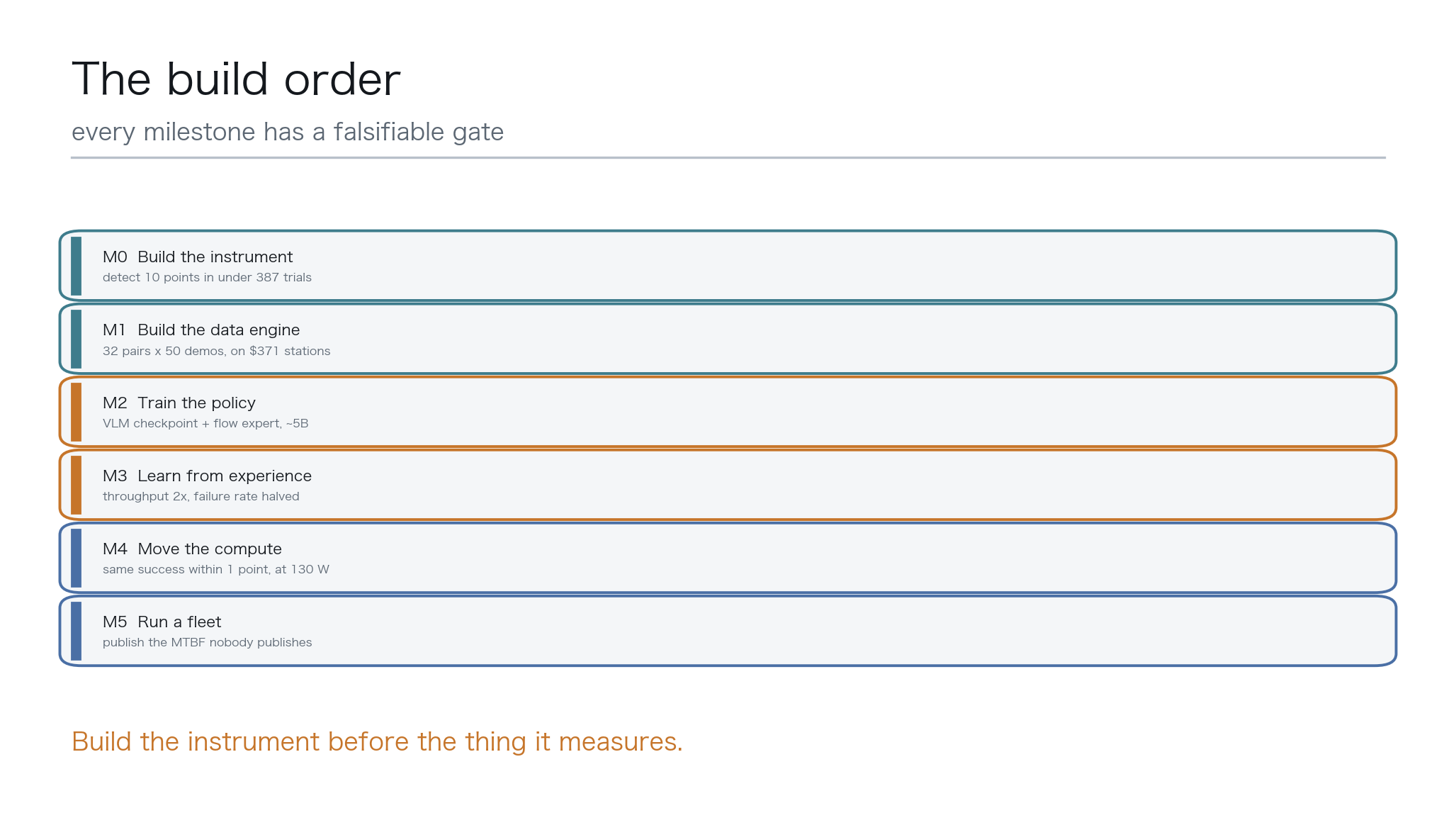
Everything before this was diagnosis. Each earlier hook is picked up by exactly one milestone, and each milestone carries a gate expressed as a number so it can fail [arXiv:2506.18123].
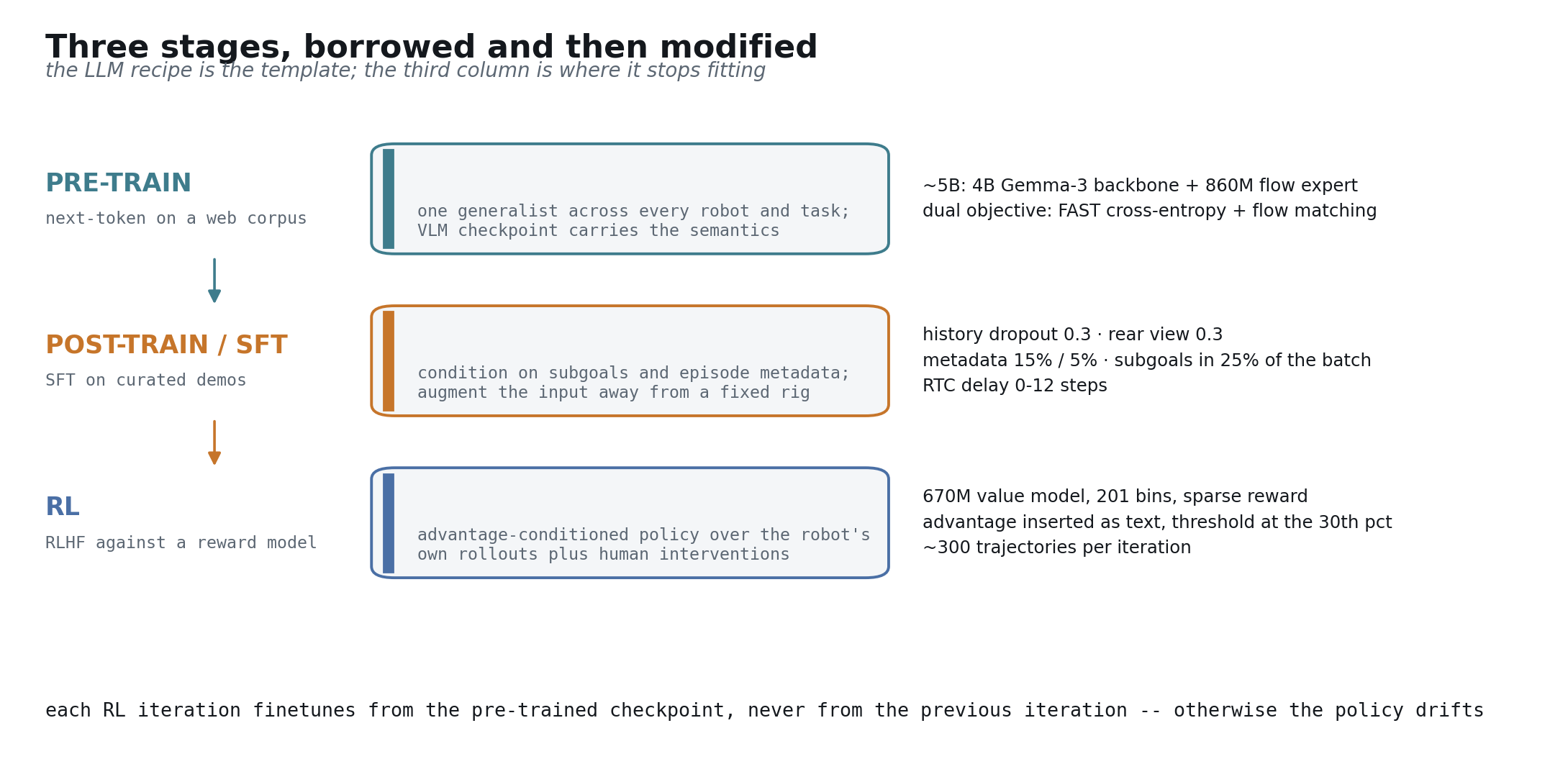
All three language-model stages transfer in form. The third one changes shape, because there is no cheap verifier and the reward has to come from the robot’s own experience [arXiv:2511.14759].
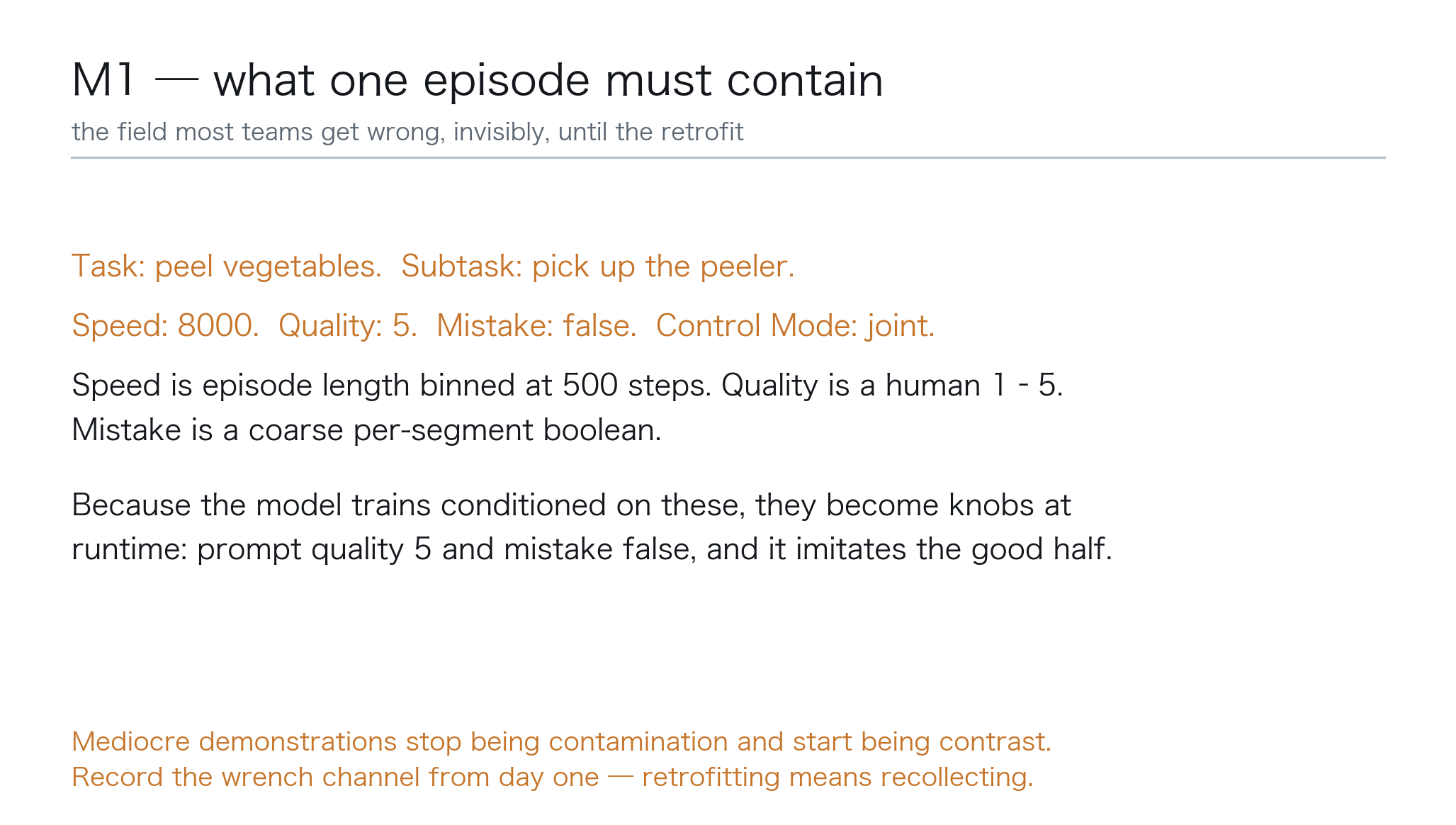
Record every episode as a conditioned example: speed binned at 500 steps, quality as a human 1 to 5, mistake as a per-segment boolean, control mode [arXiv:2604.15483 §V-C]. At runtime those become knobs — prompt quality 5 and mistake false and the policy imitates the good half of your data [arXiv:2604.15483 §VII].
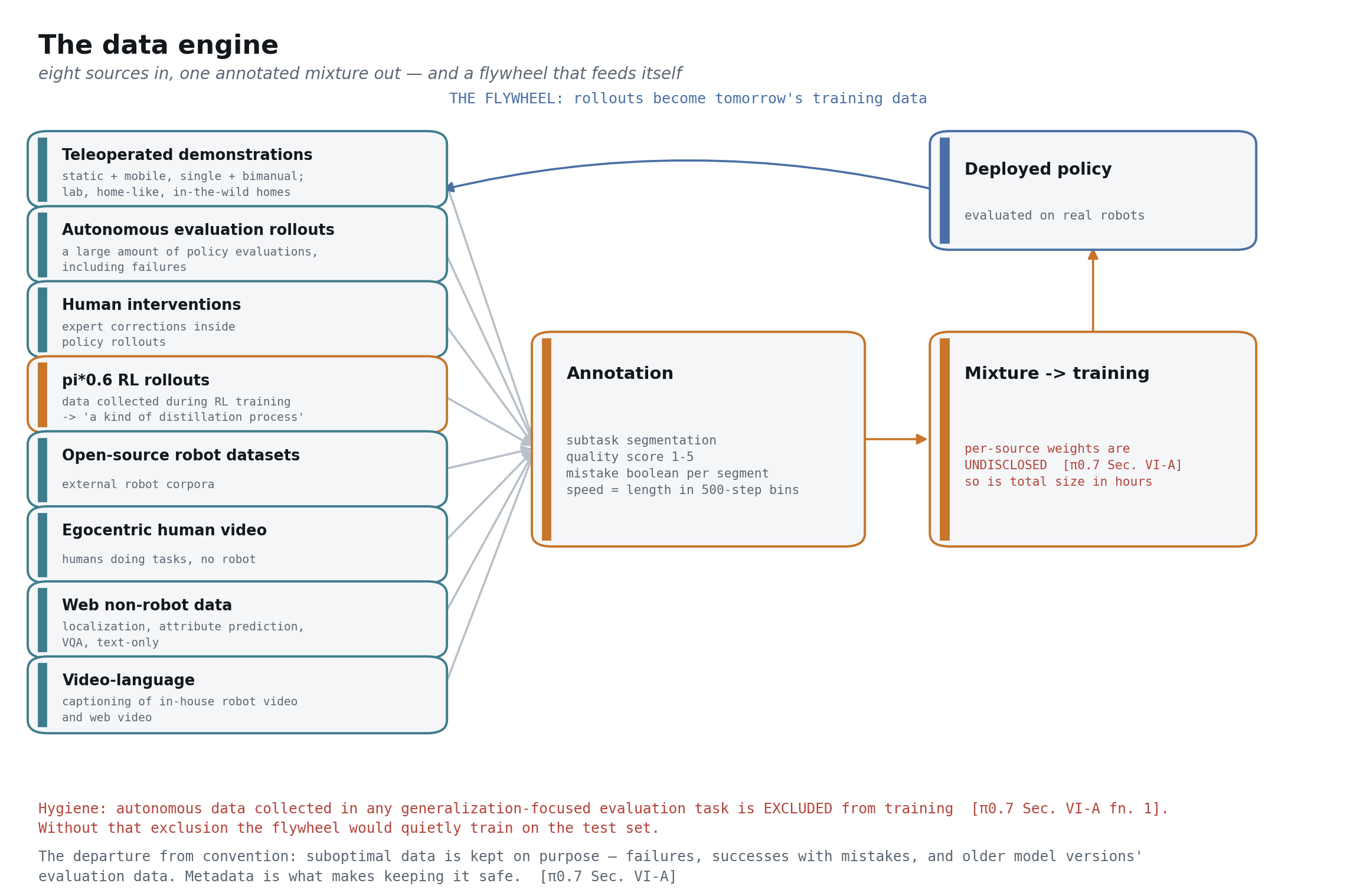
Eight sources feed one annotated mixture, and the deployed policy’s rollouts become tomorrow’s training data [arXiv:2604.15483 §VI-A]. Failures and mistake-bearing successes are kept on purpose; autonomous data from generalization evaluations is excluded, or the flywheel trains on the test set [arXiv:2604.15483 §VI-A].
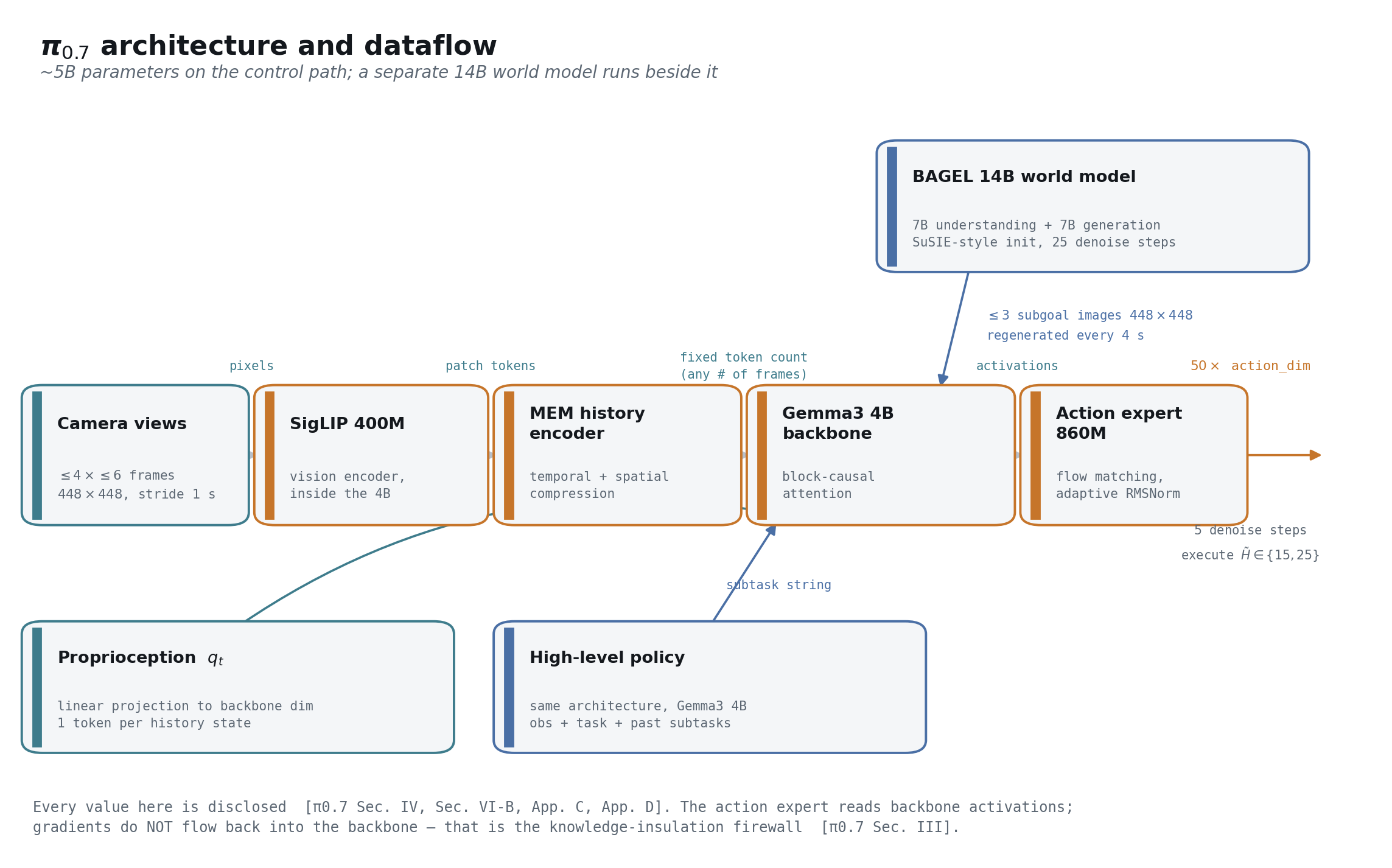
About 5B on the control path: a 400M vision encoder and a 4B backbone carrying inherited semantics, an 860M flow expert carrying motor skill, and a 14B world model running beside the loop rather than inside it [arXiv:2604.15483 §IV].
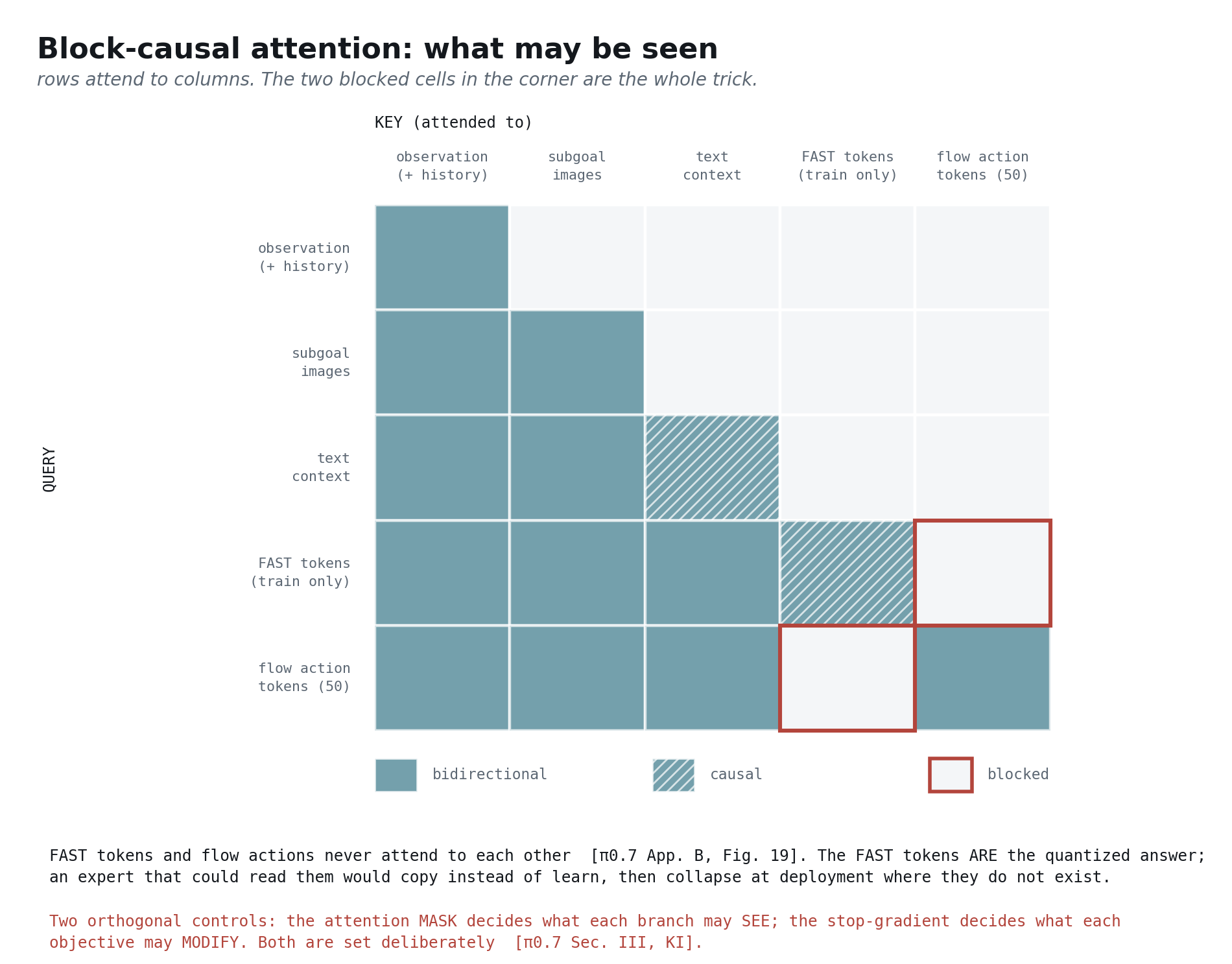
The part to copy is the firewall: gradients from the action expert do not flow back into the backbone [arXiv:2604.15483 §III]. FAST tokens exist only at training time and never attend to the flow actions [arXiv:2604.15483 App. B].
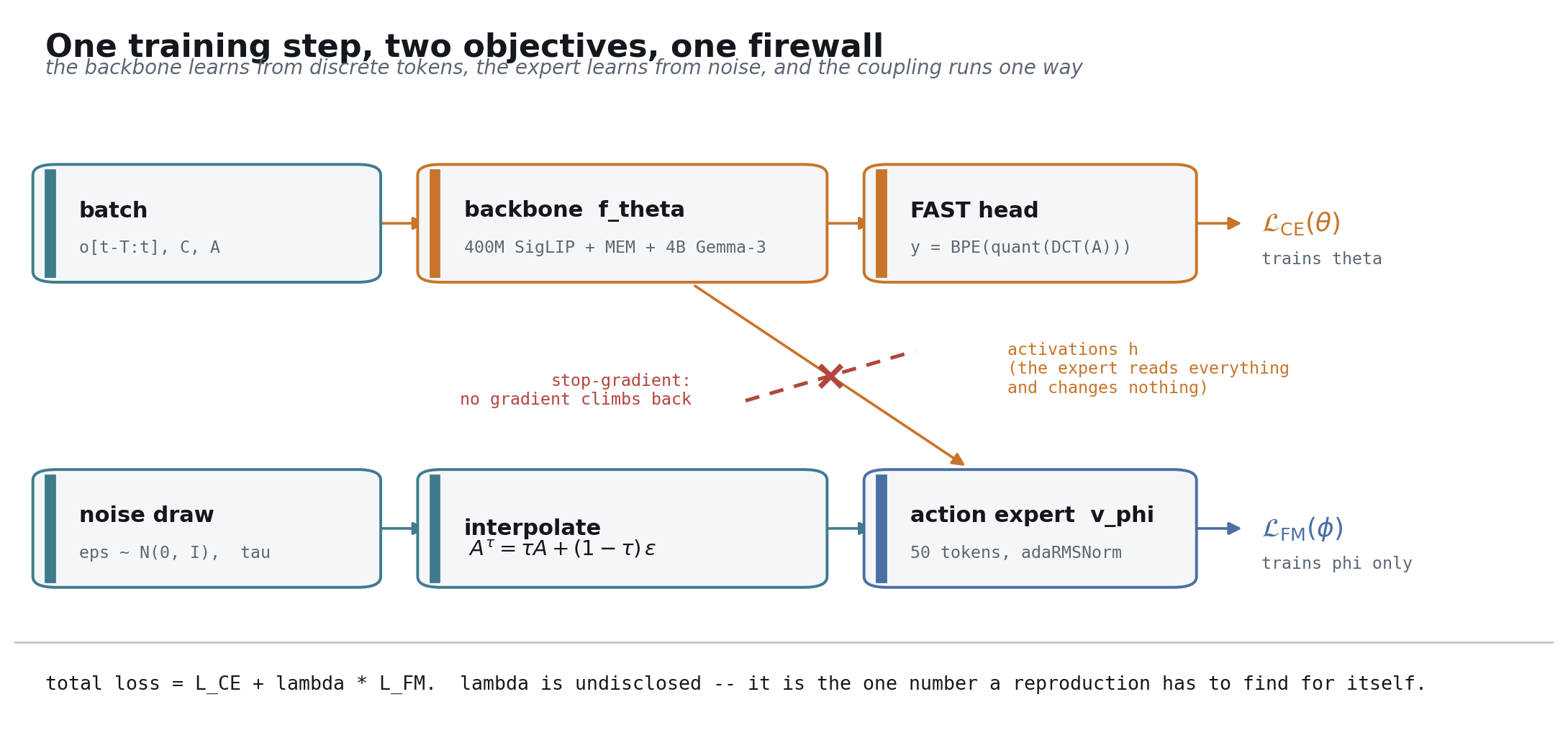
One step, two losses, two parameter groups. Cross-entropy on FAST tokens trains the backbone; flow matching trains the expert against the velocity that carries noise to actions [arXiv:2410.24164]. stop_gradient is the only coupling, and the relative weight of the two losses is the one number nobody has published [arXiv:2604.15483 §III].
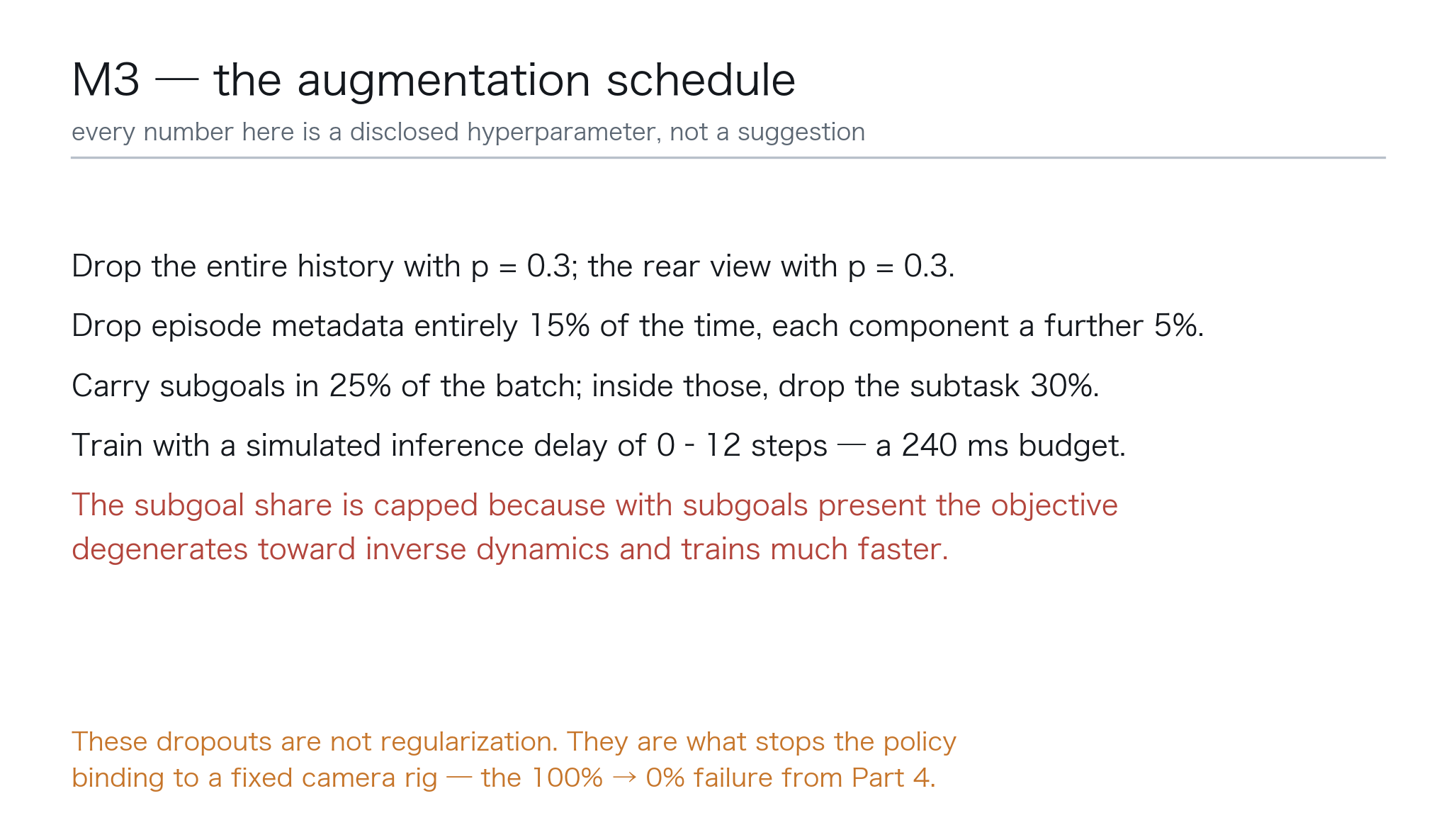
History dropped at p = 0.3, metadata at 15% and 5%, subgoals in 25% of the batch [arXiv:2604.15483 §V-E]. These are not regularization — they are what stops the policy binding to a fixed camera rig [arXiv:2409.03403].
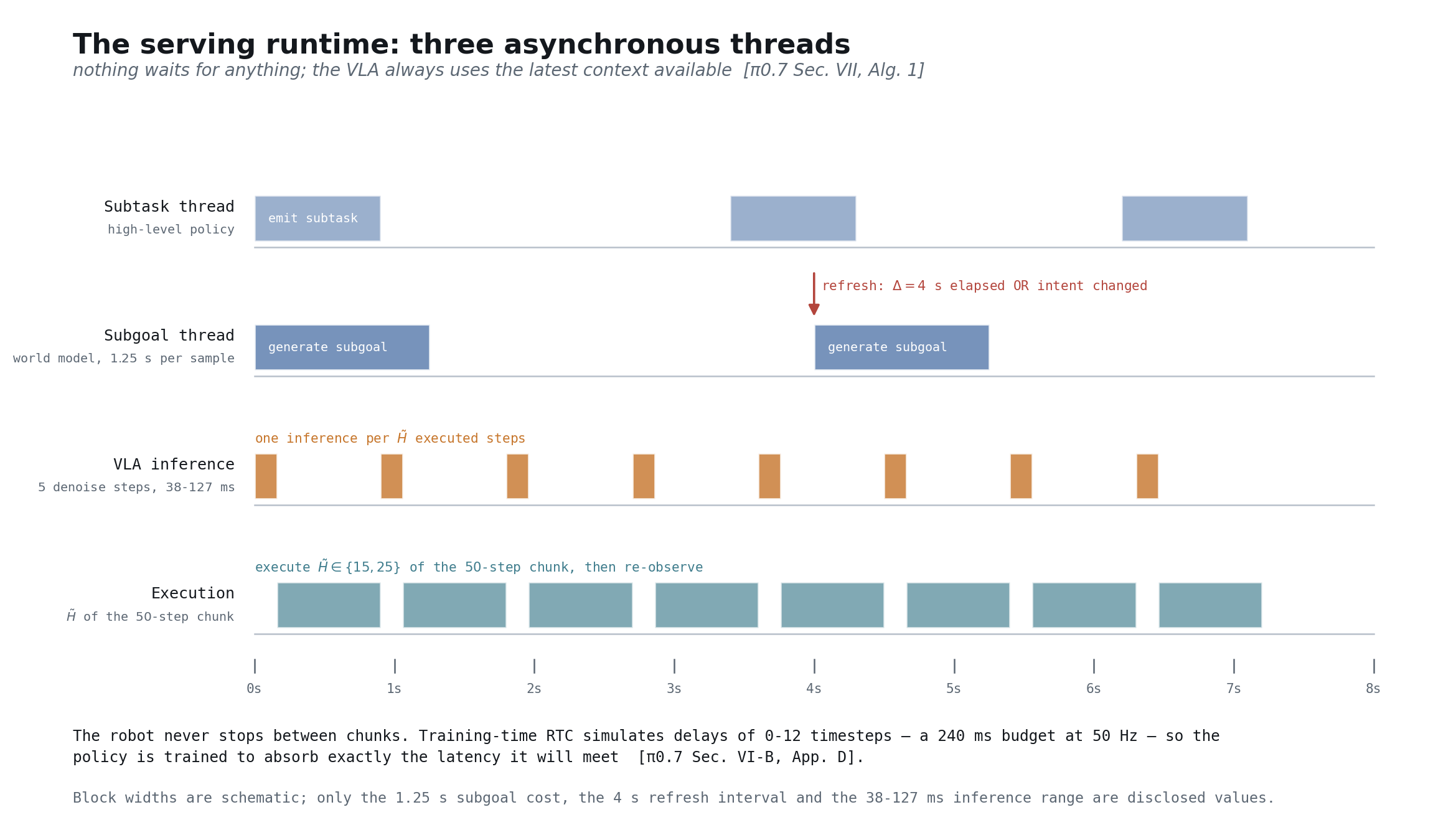
Before compressing anything, fix the schedule: three threads and nothing waits, so a 1.25 s world-model call is invisible instead of fatal [arXiv:2604.15483 §VII].
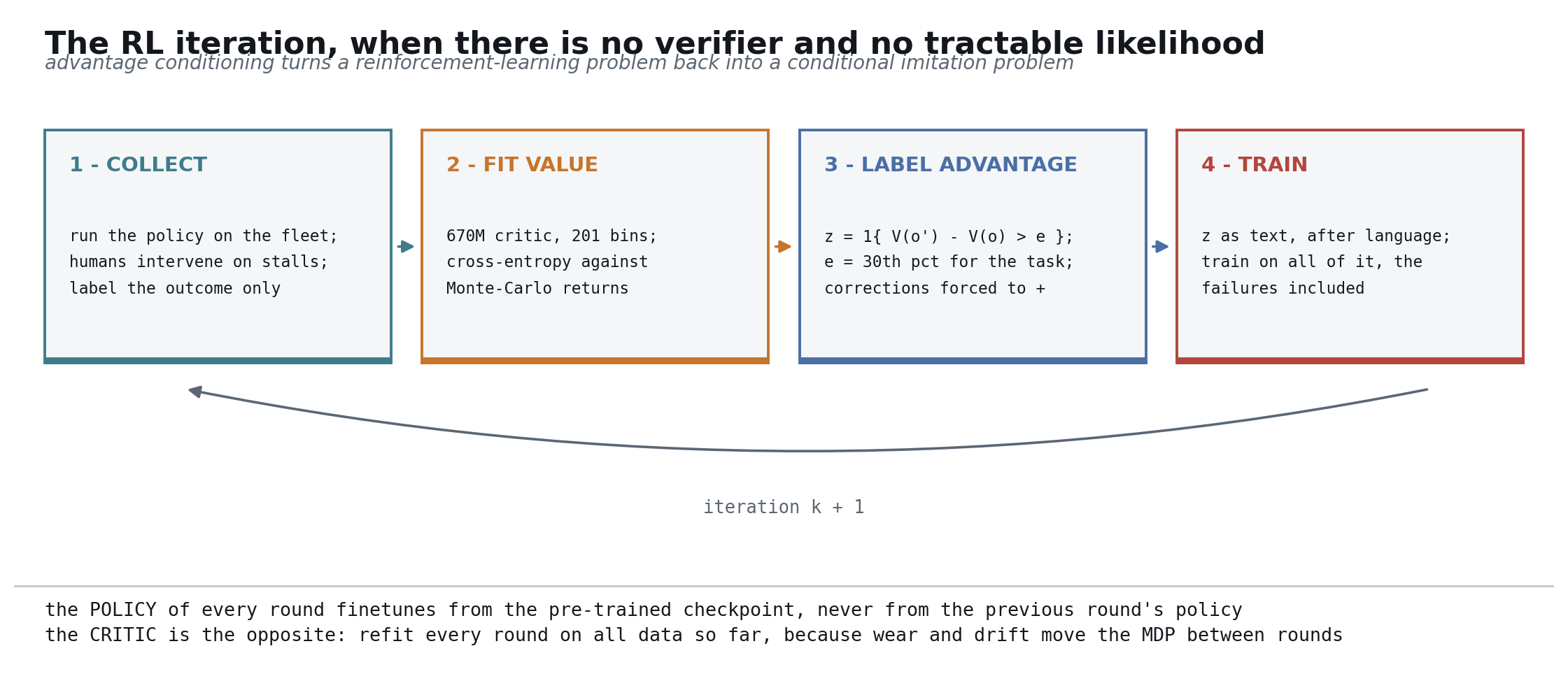
There is no cheap verifier and no tractable likelihood, so PPO and AWR both lose to conditioning [arXiv:2511.14759]. Fit a critic, binarize its one-step difference against the 30th percentile for that task, write the result into the prompt as text, and train supervised on everything — failures included [arXiv:2511.14759].
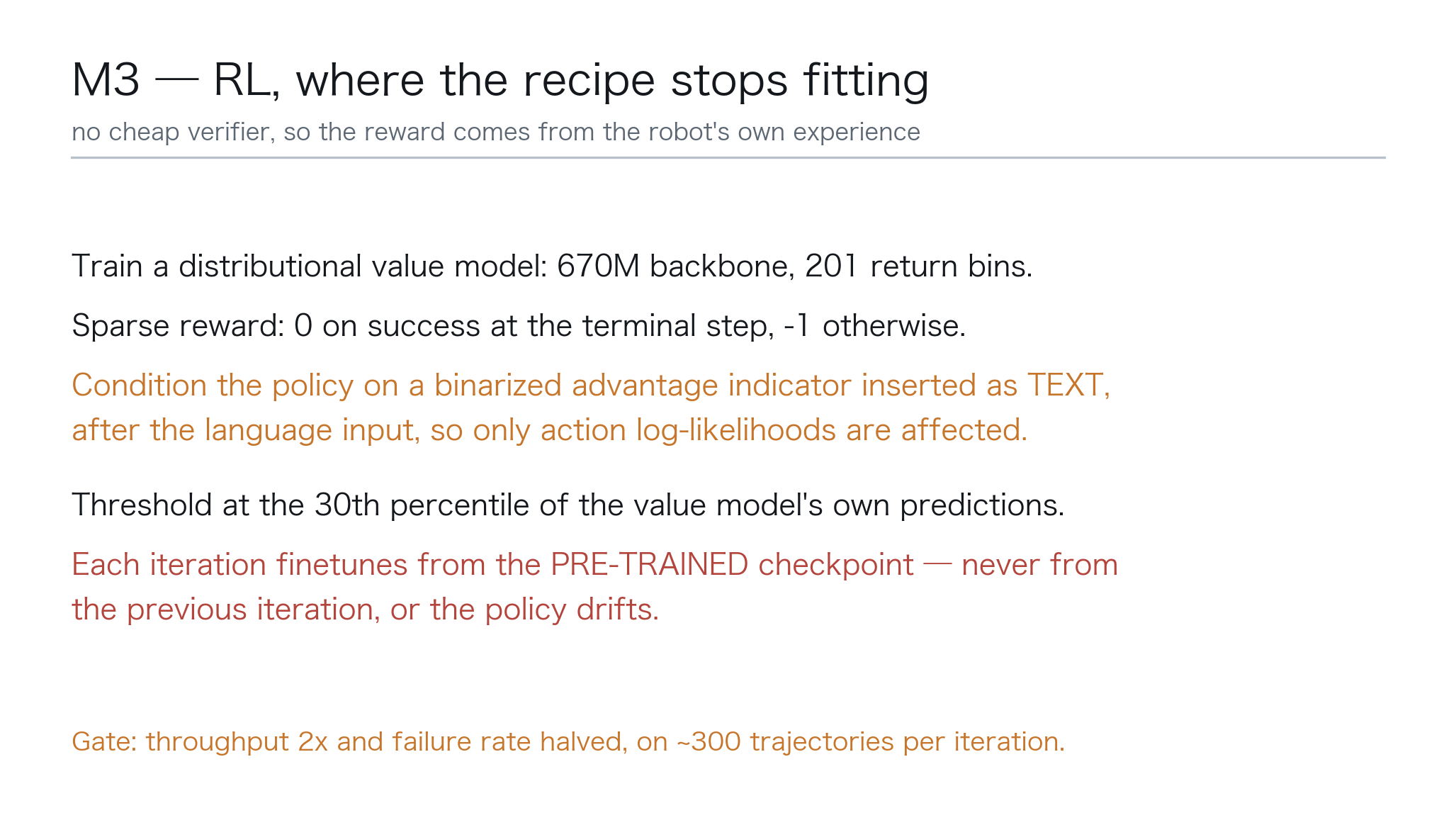
A 670M distributional value model over 201 bins, a sparse reward, and a binarized advantage indicator inserted as text after the language input [arXiv:2511.14759]. Each iteration’s policy finetunes from the pre-trained checkpoint, never from the previous iteration’s policy, or it drifts; the critic is the opposite and is refit every round on everything collected so far [arXiv:2511.14759].
M4 is where the product thesis is paid for: per-robot compute drops to $3,499 at 40 to 130 W, against a datacentre GPU at 700 W [computed: EDGE-19 against EDGE-25].
Part 6 — Three open bets
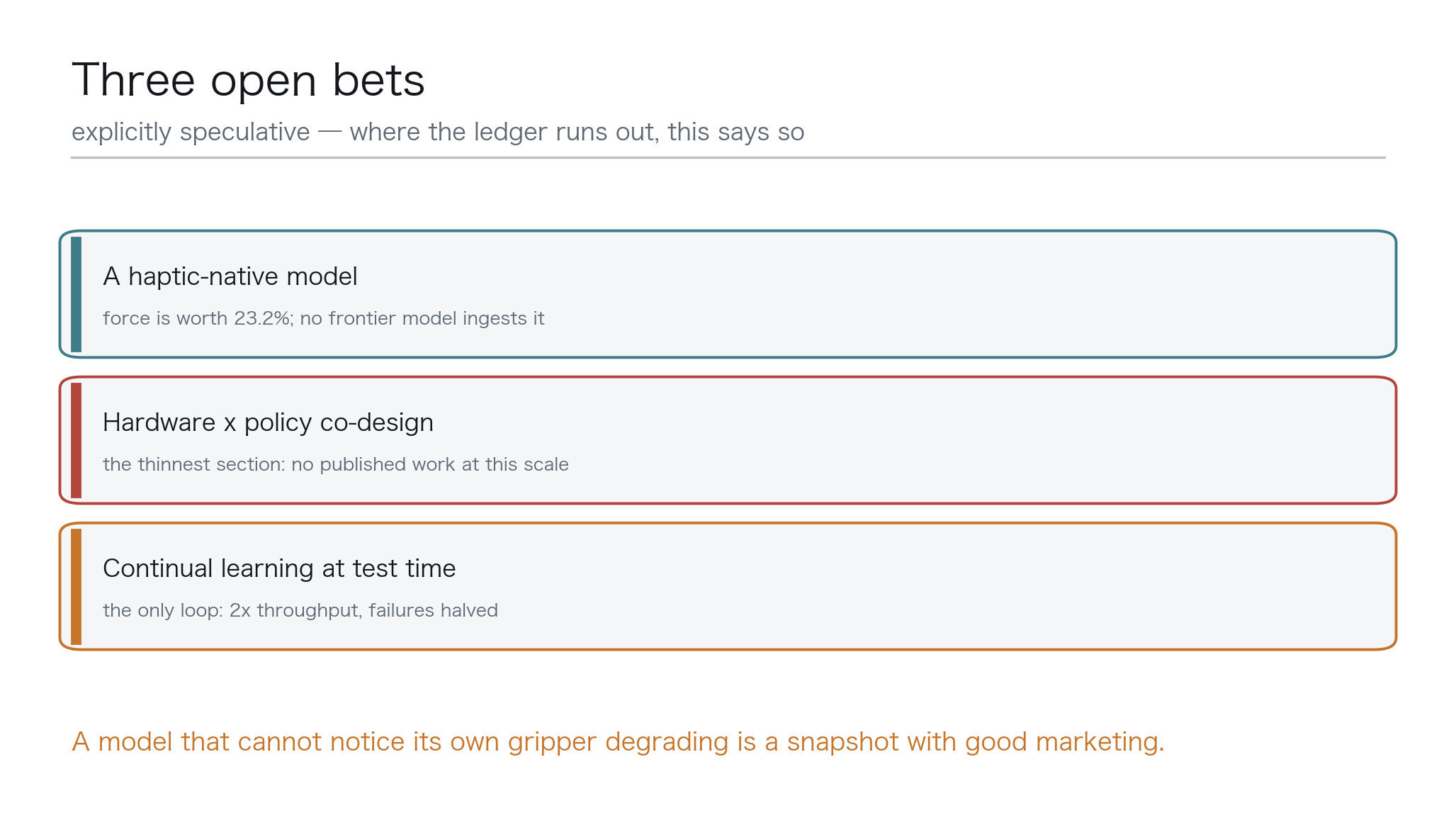
Speculative, and marked as such. Force is worth 23.2% on average and no frontier model ingests it [arXiv:2505.22159]. Hardware-and-policy co-design has no published work at this scale, so it is posed as a question [arXiv:2604.15483]. The only self-improvement loop reports 2x throughput and halved failures [arXiv:2511.14759].
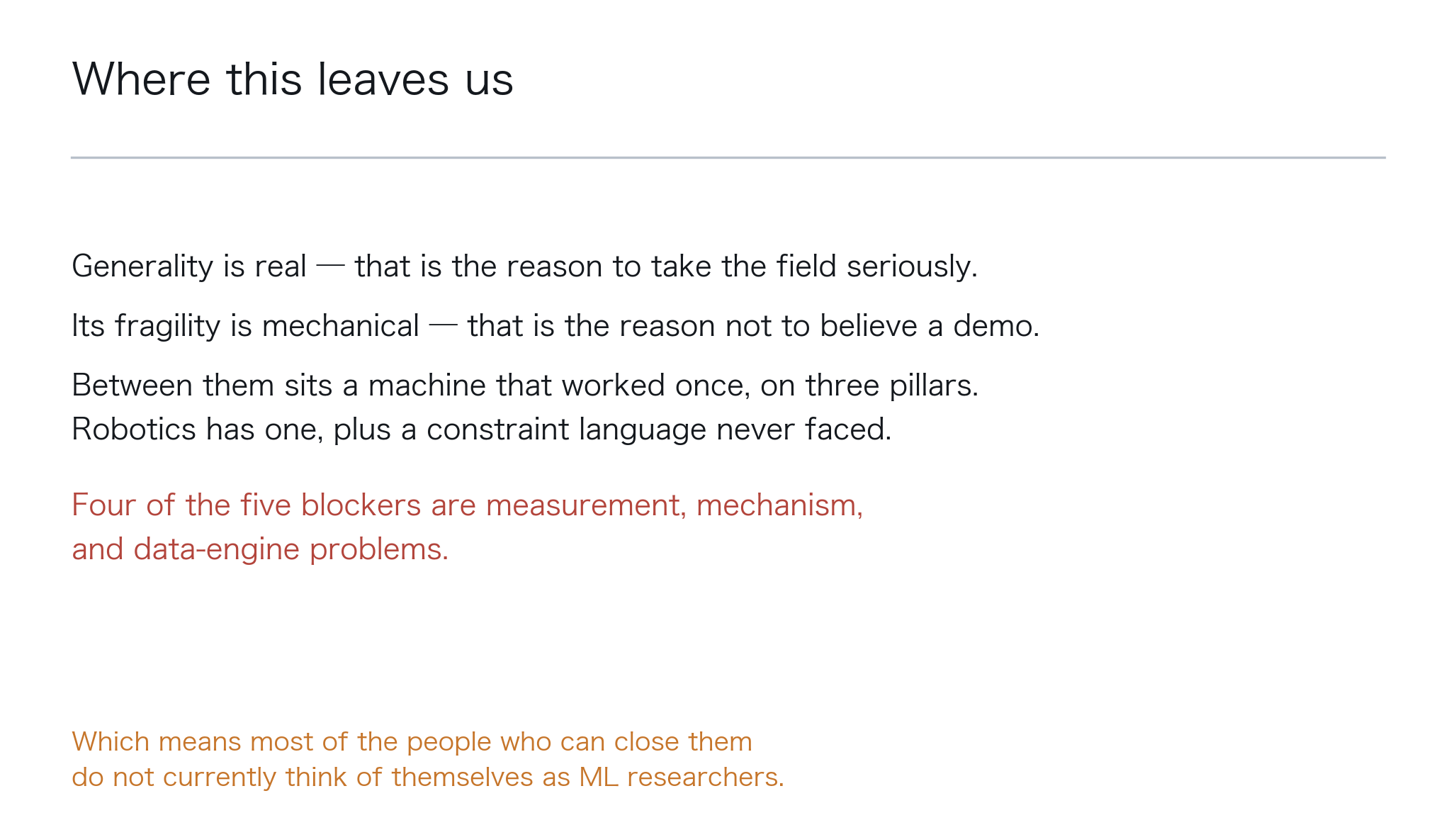
Four of the five blockers are measurement, mechanism, and data-engine problems — which means most of the people who can close them do not currently think of themselves as machine-learning researchers [arXiv:2506.18123].
The long-form edition carries the full argument, the gap ledger, and the bibliography [arXiv:2604.15483].